


The future of finance is on-chain
Digital transformation of the global financial system has moved beyond theoretical exploration. Financial tokenization is no longer a peripheral technology but the infrastructure supporting capital markets. For institutions, the transition to on-chain finance represents a fundamental shift in how value is created, managed, and settled, offering a level of transparency and speed that legacy systems cannot match.
The Challenge: Structural limitations in traditional finance

Operational inefficiencies and high costs
Traditional finance (TradFi) relies on fragmented, siloed systems and manual intermediaries. From clearinghouses to custodial banks, the layers of administration required for asset management result in high operational overhead and settlement delays (T+2 or longer). These manual processes increase the risk of human error and inflate transaction costs for both issuers and investors.

Limited liquidity for private assets
Private markets, including private equity, debt, and real estate, have historically suffered from restricted liquidity. The high barriers to entry and the lack of efficient secondary trading venues mean that capital is often locked for years. This "illiquidity discount" hampers portfolio optimization for institutional investors and limits the growth of private market assets.

Fragmented infrastructures and barriers to entry
Institutional participation in new markets is often slowed by disparate regulatory requirements and incompatible technological stacks. The absence of a unified, compliant infrastructure makes it difficult for institutions to scale their digital asset offerings across different jurisdictions without facing significant legal and technical roadblocks.
The solution: Tokenization as a regulated gateway to digital assets
Tokenization serves as the critical bridge that aligns the rigorous security standards of traditional finance with the programmable efficiency of the digital era. By transforming financial instruments into digital assets, institutions can overcome legacy bottlenecks through a unified, regulated framework.
What is financial tokenization?
Financial tokenization is the process of converting ownership rights in a financial asset into a digital token on a blockchain. These tokens act as programmable vehicles for value, representing anything from equity in a firm to a fractional share of a private credit fund. By moving these assets onto a distributed ledger, institutions gain a "single source of truth" for ownership and transactions.
Bridging TradFi Strengths with DeFi Innovation
Tokenization does not replace the security of traditional finance; it enhances it .By integrating institutional-grade compliance with blockchain’s settlement capabilities, Brickken provides a regulated gateway where institutions can benefit from 24/7 markets and programmable smart contracts while operating within existing legal frameworks.
What financial instruments can be tokenized?
Brickken’s Tokenization Infrastructure is built to support a diverse range of financial instruments, including:
- Private Equity & Debt: Digitizing ownership and credit streams for easier distribution.
- Bonds & Fixed Income: Automating coupon payments and maturity settlements.
- Investment Funds: Creating tokenized versions of VC, PE, and Hedge Funds for fractional access.
- Real Estate & Commodities: Transforming tangible assets into liquid, tradable digital securities.
Unlocking new possibilities for capital and liquidity
By digitizing these instruments, institutions can unlock capital that was previously trapped in illiquid formats. Tokenization enables the creation of new financial products, such as index tokens for RWAs or automated collateralized lending against digital securities, providing a more dynamic and responsive capital market.
Key advantages of financial tokenization for institutions
Drastically enhance operational efficiency
Smart contracts automate the entire lifecycle of a financial instrument including transactions, compliance checks and record-keeping. This automation significantly reduces the need for manual reconciliation, lowering administrative costs and shortening processing times from days to seconds.

Improve asset liquidity and unlock capital
Through fractionalization, large-scale assets can be divided into smaller, more accessible digital tokens. This lowers the entry barrier for a wider range of institutional and professional investors, facilitating and increasing the overall velocity of capital.
Access a new global investor base
A single, unified digital platform connects institutions to a borderless investment ecosystem. Tokenization allows issuers to reach new pools of capital from global markets, Web3-native institutions, and tech-forward family offices that prefer the transparency and ease of digital asset management.

Automate yield distribution and reporting
Brickken’s infrastructure handles the complexities of corporate actions automatically. Smart contracts execute yield distributions, dividend payments, and real-time reporting to investors, ensuring that all stakeholders have instant access to accurate financial data and their respective payouts.
Brickken’s platform: All-in-one infrastructure, tailored to you
End-to-end lifecycle management
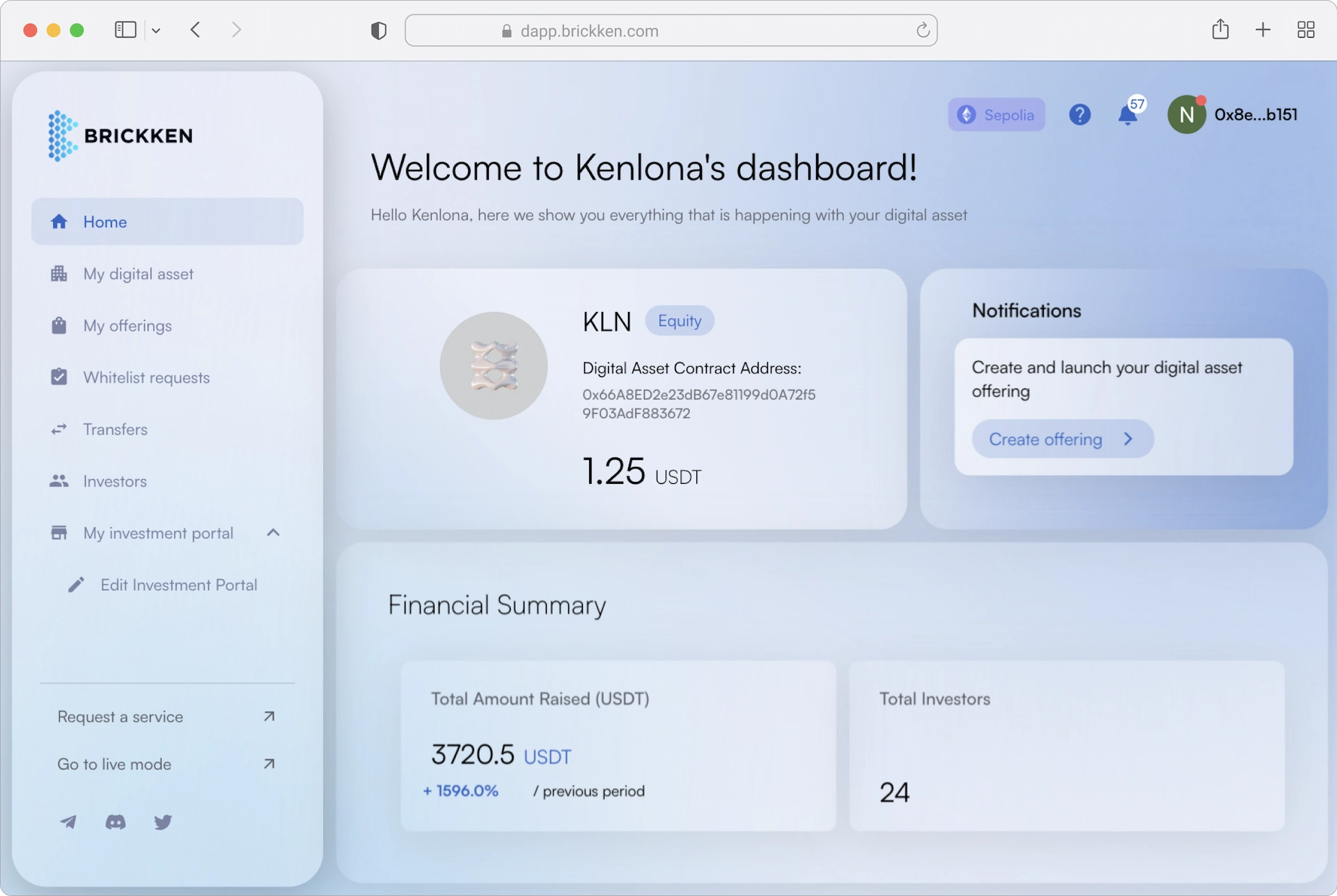
Brickken provides a complete environment for managing the digital asset lifecycle. From the initial legal structuring and asset issuance to investor onboarding and post-issuance management, our platform ensures a seamless experience for both the issuer and the investor.
Institutional-grade security & european compliance
Security is at the core of our technology. Brickken’s infrastructure is ISO 27001 certified and strictly aligned with MiCA (Markets in Crypto-Assets) and DORA (Digital Operational Resilience Act) regulations.
.webp)
Whitelabel: Your brand, our proven technology
Maintain your corporate identity while deploying world-class tokenization infrastructure. Our White-Label solution allows financial institutions to offer a fully branded marketplace and issuance dashboard, powered by Brickken’s battle-tested protocol, under their own domain and aesthetic.
API integration: Full flexibility and control
For institutions with existing software ecosystems, our API-native mode provides the building blocks to integrate tokenization directly into your current workflow. Programmatically manage assets and investors while maintaining full control over the user experience.
The State of RWA Issuers: Brickken Research
The State of RWA Issuers research shows capital formation,
regulatory navigation, and operational efficiency are driving
adoption of RWA.
This institutional report explores how tokenization is reshaping private markets, financial instruments, and global capital infrastructure. Discover the trends, regulatory developments, and infrastructure standards driving the next phase of tokenized financial markets.
✔ 2026 market trends.
✔ Institutional adoption drivers.
✔ Infrastructure & compliance insights.
✔ Capital markets transformation.
Download the report
Frequently asked questions
Smart contracts embed regulatory requirements directly into the token's code. This ensures that actions like transfers or distributions only occur if specific conditions are met, such as valid KYC/AML status or jurisdictional restrictions, making compliance "programmable" and self-executing.
Yes. Brickken’s infrastructure is designed to be adaptable to any jurisdiction. We work alongside legal partners to ensure that help projects assure any issuance adheres to local securities laws.
The process begins with legal structuring and asset valuation. Once the framework is set, you use Brickken's dashboard to set up your Digital Asset Store (SaaS or Whitelabel), onboard investors through our automated KYC portal, and launch your tokenized offering to your target market.