Tokenization solved issuance before it solved distribution.
Today, creating a tokenized financial instrument is no longer the primary challenge. The technology exists. Regulatory frameworks are emerging. Infrastructure providers can issue tokenized bonds, funds, private credit products, and other financial instruments across multiple jurisdictions.
The harder question is what happens next.
How do tokenized financial instruments reach investors? How do they move between platforms? How do issuers maintain compliance while accessing broader liquidity networks? And what market infrastructure is required for tokenized assets to operate at scale?
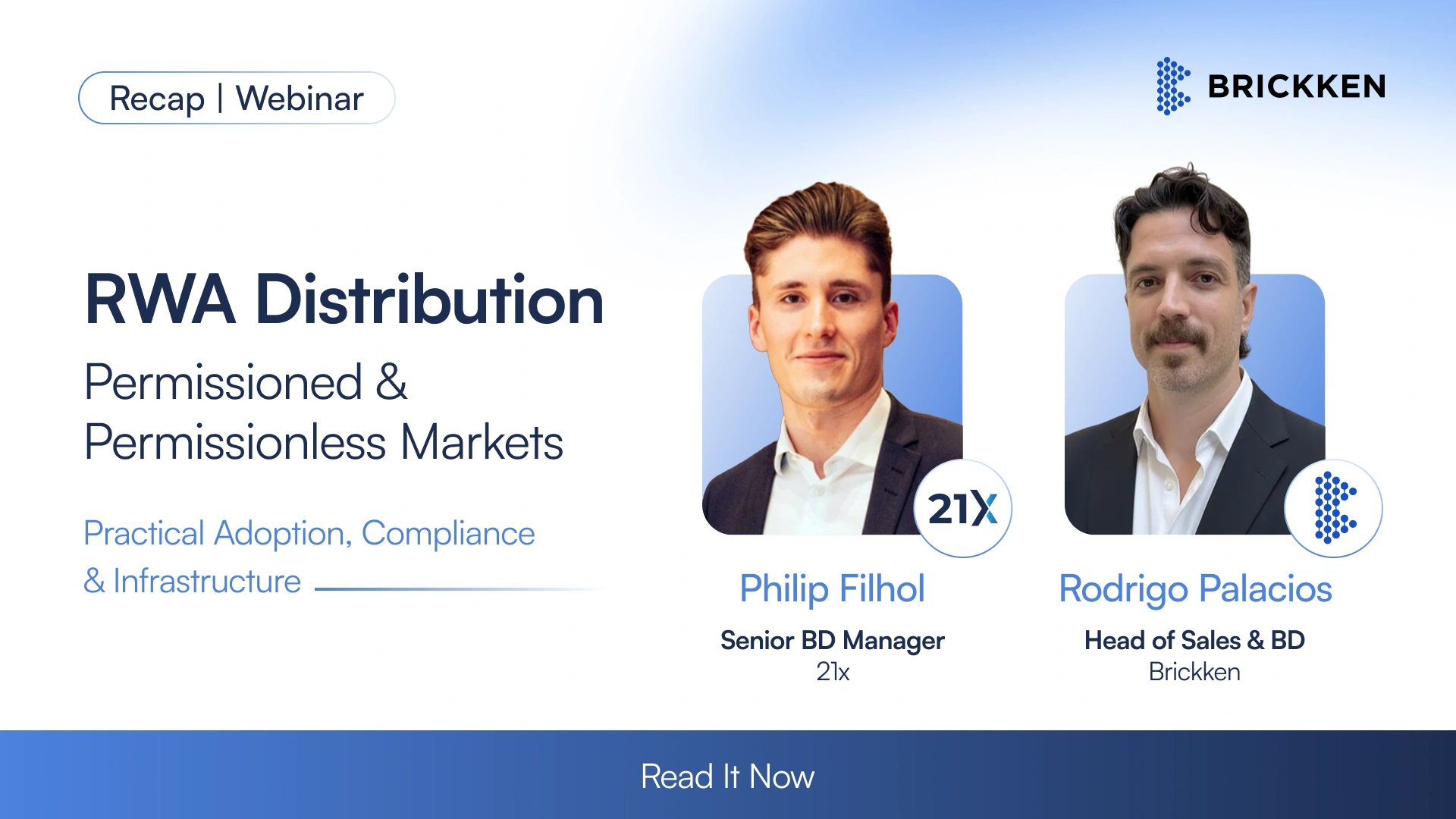
These were the central questions discussed during Brickken's recent webinar with Philip Filhol, Senior Business Development Manager at 21X, Europe's first regulated DLT trading and settlement system.
The discussion revealed an industry moving beyond token creation and into the more complex challenge of distribution.
One of the clearest signals of market maturity is where adoption is occurring.
According to Filhol, tokenization has moved beyond experimentation and into distinct market segments with different objectives.
On the retail side, crypto-native platforms are expanding beyond digital assets and introducing tokenized financial products alongside existing cryptocurrency offerings. Exchanges increasingly want to become a single destination for investment activity rather than remain exclusively crypto-focused. For investors already active on these platforms, tokenized financial instruments become a natural extension of existing behavior.
Institutional adoption follows a different path.
Rather than seeking speculative opportunities, asset managers, market makers, and financial institutions are focused on operational efficiency, collateral mobility, and new forms of utility. Tokenized money market funds, private credit instruments, and fixed-income products are increasingly being evaluated through the lens of infrastructure rather than innovation.
The distinction matters because it highlights a broader reality: tokenization is serving different problems for different participants.
A recurring theme throughout the conversation was that successful tokenization projects increasingly combine legal structures, regulatory frameworks, and technical infrastructure.
Tokenization providers are no longer simply technology companies.
They are becoming specialists in securities law, market structure, and cross-border distribution.
As Filhol explained, leading market participants have spent years identifying the regulatory frameworks that best support tokenized financial products. Jurisdictions, issuance vehicles, governing law, investor eligibility requirements, and transfer restrictions are now strategic considerations that shape how assets are distributed.
The issue is not technological.
It is structural.
A tokenized instrument only becomes valuable when it can move efficiently between issuers, investors, custodians, trading venues, and liquidity providers while maintaining compliance requirements.
That is ultimately a distribution problem.
One of the most important developments highlighted during the webinar was the growing convergence between crypto-native infrastructure and regulated financial markets.
Large exchanges that originally focused exclusively on digital assets are increasingly pursuing traditional financial licenses alongside crypto licenses. This allows them to offer both digital assets and regulated financial instruments under the same infrastructure stack.
In Europe, this trend is particularly visible as firms combine MiCA authorization for crypto assets with MiFID permissions for financial instruments.
The result is a new category of platform.
These are no longer purely crypto exchanges. They are becoming regulated investment platforms capable of supporting tokenized financial products alongside digital assets.
This shift has significant implications for distribution.
Tokenized financial instruments gain access to audiences, liquidity pools, and investor networks that already exist rather than requiring entirely new ecosystems to be built from scratch.
The webinar also explored one of the most important architectural decisions facing issuers today.
Should tokenized assets operate within permissioned environments or permissionless ecosystems?
According to Filhol, most regulated offerings begin with permissioned onboarding. Investors complete KYC procedures, compliance checks, and eligibility verification before receiving access to an instrument. The difference emerges in what happens afterward.
Permissioned models require every participant in the transaction chain to be approved before assets can move.
Permissionless models maintain compliance at issuance while allowing broader transferability and composability once assets enter the market.
This distinction directly affects how tokenized assets interact with wider liquidity networks, lending protocols, decentralized exchanges, and other forms of digital financial infrastructure.
The trade-off is clear.
Permissioned systems maximize control.
Permissionless systems maximize interoperability.
The challenge for the market is determining where each model creates the greatest value.
Another important takeaway concerned the types of financial instruments seeing the strongest adoption.
Contrary to early expectations, tokenization has not become a replacement for traditional venture financing or startup fundraising.
Instead, adoption has concentrated around debt instruments and alternative financing structures.
Filhol noted that the overwhelming majority of tokenized private market activity today remains debt-based rather than equity-based. Companies are increasingly using tokenization as part of a broader financing strategy alongside bank lending, shareholder capital, and other sources of funding.
For many issuers, tokenization is becoming an additional financing layer rather than a replacement for existing capital markets.
This reflects a broader trend across the market: tokenization is being integrated into established financial workflows instead of attempting to replace them entirely.
Looking ahead, Filhol offered a clear prediction about where the market is heading.
Access to tokenized financial instruments will become wallet-native. Investors will increasingly acquire, trade, and manage tokenized assets directly from digital wallets without relying on separate systems or fragmented account structures.
At the same time, competition between traditional financial institutions and crypto-native platforms is expected to intensify.
The infrastructure advantages that digital asset platforms have developed over the last decade including 24/7 availability, instant settlement, wallet-based ownership, and programmable transactions are increasingly relevant to tokenized financial products.
As tokenized markets mature, the distinction between traditional financial infrastructure and digital asset infrastructure is likely to become less important.
The key differentiator will be distribution.
The institutions that succeed will not necessarily be the ones that tokenize assets first.
They will be the ones that build the most effective pathways between issuers, investors, liquidity, and regulated market infrastructure.
That is where the next phase of tokenization is being decided.

