Tokenization has moved past the pilot phase. Private equity funds, real estate developers, and credit managers are issuing digital securities today, and the institutions that serve them are being asked a direct question: can you support this?
For most, the honest answer involves a build-versus-buy decision. Developing tokenization infrastructure from scratch means hiring smart contract engineers, building KYC and AML workflows, mapping a shifting regulatory perimeter, and passing security audits, before a single asset is issued. The alternative is a white label tokenization platform: proven infrastructure, delivered under your own brand.
This article covers what the model is, why it has become central to the wider white label fintech market, and the five benefits that matter most when you evaluate providers.
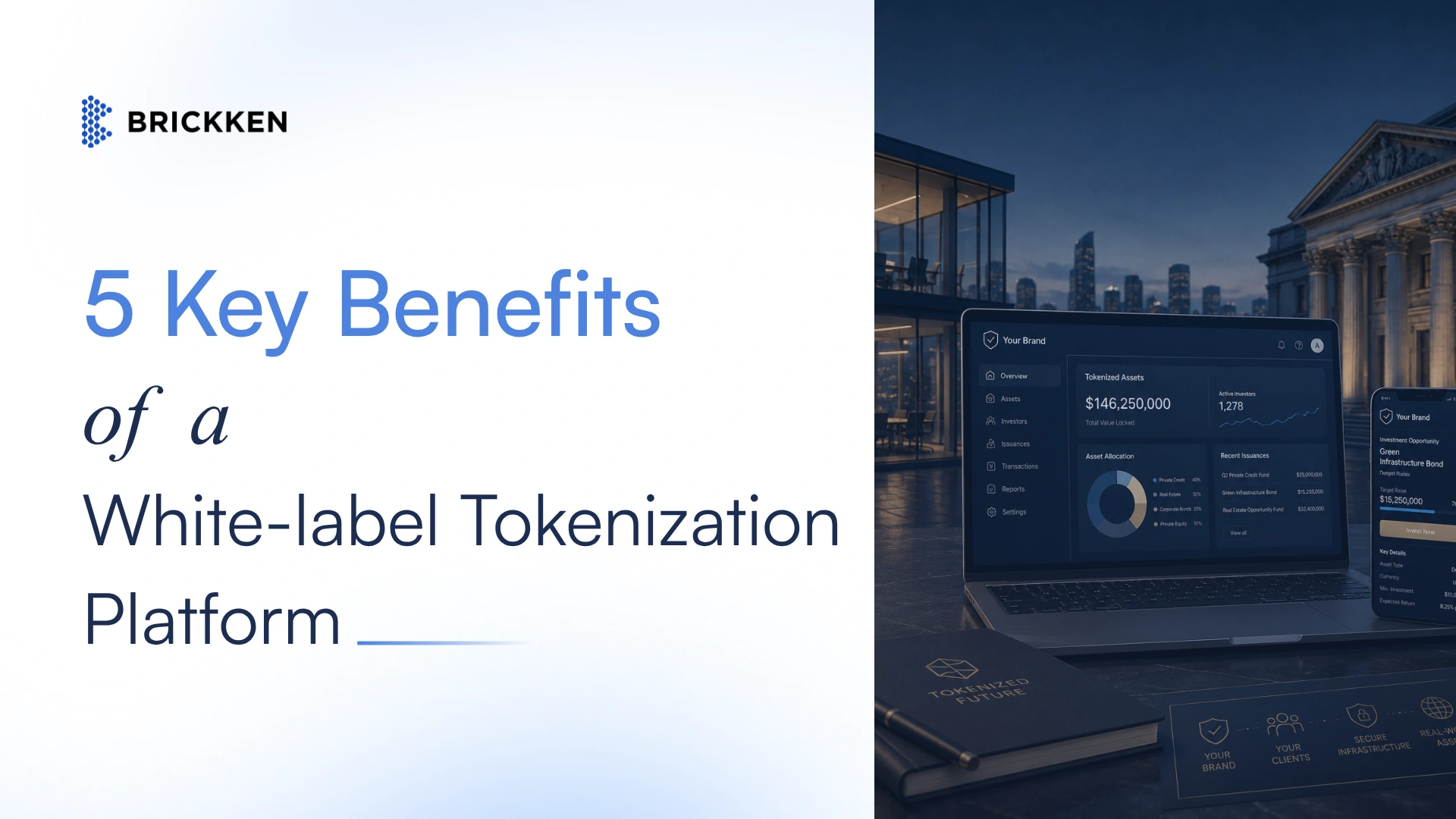
A white label tokenization platform is software that lets a company issue, distribute, and manage tokenized assets under its own brand, using infrastructure built and maintained by a third-party provider. The provider supplies the smart contracts, investor onboarding, compliance tooling, and asset lifecycle management. The client controls the brand, the domain, the client relationship, and the commercial terms.
In practice, your clients see your logo, your interface, and your URL. They never see the vendor.
This differs from the two adjacent models it is often confused with:
| Model | Who owns the brand | Best fit |
|---|---|---|
| SaaS platform | The provider (multi-tenant) | SMEs and asset managers tokenizing 1–5 assets, prioritising speed |
| White label platform | The client, fully | Enterprises and institutions offering tokenization under their own brand |
| API / headless | The client's existing product | Fintechs with engineering teams embedding tokenization into current systems |
The tokenization market did not invent this pattern. White label fintech solutions already dominate card issuing, payments, banking-as-a-service, and wealth management. Institutions learned a decade ago that competitive advantage sits in distribution, client trust, and product design, not in rebuilding rails that already work.
Tokenized real-world assets are following the same curve, with one additional pressure: regulation. In the EU, explicit requirements are set around crypto-asset services and operational resilience. Meeting them independently is a compliance programme, not a feature sprint. Fintech white label software lets institutions inherit that groundwork instead of reconstructing it.
The most immediate benefit is that every interaction stays yours.
When an investor logs in to subscribe to a tokenized fund, the login page, the dashboard, the email notifications, and the domain all carry your identity. That consistency compounds. Each issuance reinforces your institution as the venue where these opportunities happen, rather than as an intermediary pointing clients to someone else's portal.
For a bank or asset manager, this is not cosmetic. Sending clients to a third-party marketplace weakens the relationship and creates an obvious path for those clients to be marketed to by someone else.
Meaningful white labelling goes well beyond a logo swap. Look for:
Brickken's white label deployment gives enterprises full customization: the investor portal and interface reflect the client's brand identity, not Brickken's.
A tokenization stack is not one product. It is a token engine, an investor portal, a KYC and AML layer, a cap table and registry, a payments and settlement path, a reporting module, and a security programme wrapped around all of it.
| Cost factor | In-house build | White label platform |
|---|---|---|
| Engineering team | Blockchain, backend, frontend, DevOps hires | None required |
| Regulatory work | Legal counsel per jurisdiction, from zero | Framework inherited from provider |
| Security | Independent audits, penetration testing, certification | Provider-maintained |
| Time to first issuance | Typically multi-quarter | Weeks |
| Ongoing cost | Full team salary plus maintenance | Subscription or licence |
| Chain upgrades and new standards | Your roadmap problem | Included in the platform |
The comparison that trips institutions up is the maintenance line, not the build line. A build has an end date; blockchain infrastructure does not. Chains fork, standards evolve, regulations tighten, and audits recur annually. A white label model converts an unbounded engineering commitment into a predictable operating cost.
The same logic drove adoption of the white label investment platform model in wealth management. Nobody builds a custody and reporting stack from scratch anymore to launch a discretionary portfolio service.
Speed is where the model earns its keep and where the strategic risk of building sits.
Tokenization mandates arrive with deadlines. An asset manager wants a tokenized fund open for subscription this quarter. A developer needs a raise structured before a construction milestone. If your answer is "we're eighteen months from launch," the mandate goes to a competitor who was already live.
A white label platform inverts the sequence. The infrastructure exists, so the work shifts to what only you can do: legal structuring, asset valuation, investor pipeline, and distribution strategy. Brickken's white label platform is designed to go live in around two weeks under a custom domain, with no code required from the client.
That speed also changes how you can test the market. Instead of committing years of budget to a thesis about tokenized white label investment funds, you launch one issuance, measure investor appetite, and expand from evidence.
Buying infrastructure also means buying the accumulated engineering and regulatory work behind it.
A mature platform arrives with capabilities that would each be a project on their own:
Your platform improves without your team touching it. Providers ship new features, chain integrations, API expansions, and regulatory updates continuously — for example, expanded admin tooling for managing investors, clients, and digital assets, and broader API capabilities for technical teams. In a build scenario, every one of those items competes for your engineers' time against your actual product roadmap.
The final benefit is optionality. Your first tokenized asset is rarely your last, and the second one is usually different from the first.
Regulation, investor demand, and asset classes all move. A configurable platform lets you adjust onboarding rules, add jurisdictions, or change transfer restrictions as conditions change, without a development cycle. Institutions that hard-coded assumptions into a custom build in 2021 have spent the years since unpicking them.
Scale runs in two directions:
Brickken also supports migration between plans as a business scales, so a SaaS pilot can move to full white label deployment without rebuilding.
Four questions separate real white label infrastructure from a rebranded demo:
If you are weighing specific providers, our Brickken vs DigiShares comparison puts white-label setup fees, monthly plans and API access side by side, based on each company's public pricing.
What is a white label tokenization platform? It is ready-built software for issuing and managing tokenized assets that operates under the client's own brand and domain. The provider maintains the blockchain infrastructure, compliance tooling, and investor onboarding; the client owns the brand and the client relationship.
How long does it take to launch one? Deployment is typically measured in weeks rather than months. Brickken's white label platform is built to go live in around two weeks. The longer variable is usually the client's own legal structuring and asset valuation, not the technology.
Is a white label platform cheaper than building in-house? An in-house build requires a specialist engineering team, jurisdiction-by-jurisdiction legal work, and independent security audits, followed by permanent maintenance. A white label model replaces that with a predictable subscription or licence cost. A white label fintech removes the need to fund a specialist team and maintain the stack; the comparison depends on scope and volume
What is the difference between white label and SaaS tokenization? SaaS is multi-tenant and branded by the provider, which suits SMEs tokenizing a small number of assets. White label is single-brand infrastructure for enterprises and institutions that need to offer tokenization under their own identity, with full customization and control.
Which assets can be tokenized? Equity, debt, bonds, funds, real estate, private equity, and private credit are the common categories. The platform handles the token mechanics; the permissible structure depends on your jurisdiction and legal setup.
Can we offer tokenization to our own clients? Yes. That is a primary use case. Banks, asset managers, venture capital firms, and family offices use white label infrastructure to provide tokenization services under their own brand, generating fee revenue from the service.
The five benefits reinforce each other. A white label tokenization platform protects your brand equity, costs materially less than an in-house build, launches in weeks instead of years, delivers institutional-grade technology and compliance from day one, and scales as your asset programme grows.
Underneath all five sits a single question: is tokenization infrastructure the product you want to build, or the capability you want to offer? For almost every bank, fund, and fintech, the differentiation is in distribution and client trust — not in maintaining smart contracts.
Brickken provides the full stack, branded issuance dashboard, investor portal, compliance tooling, and lifecycle management, deployable on your own domain in around two weeks, backed by certified infrastructure.
Request a demo to see how a white label deployment would work for your institution, or explore the white label ecosystem to see who is already building on it.

