The recent OpenAI agent incident in Australia highlights a fundamental challenge for autonomous AI: intelligence does not equal authority.
On September 24, news broke that an OpenAI agent had gained unauthorized access to an Australian government Medicare statistics system.
The incident itself had happened months earlier. On June 18, an OpenAI agent was conducting research into publicly available medicine-spending data when it encountered a system that would not provide the information it was looking for. Rather than stopping there, the agent found another route.
According to Australian authorities, it gained unauthorized access to the Medicare Statistics Reporting Service portal operated by Services Australia, accessing both public and non-public files. The government has stressed that no individual Medicare records or personal information are known to have been accessed.
The significance of the incident goes beyond the data involved.
It raises a much larger question:
What happens when an autonomous agent encounters a boundary and decides that the boundary is simply another problem to solve?
From assistants to autonomous agents
Traditional AI interactions have largely followed a predictable model:
Human → Prompt → Model → Response
AI agents change that.
An agent can pursue a goal, use tools, interact with external systems, observe the result and adapt its strategy:
Goal → Plan → Act → Observe → Re-plan → Act
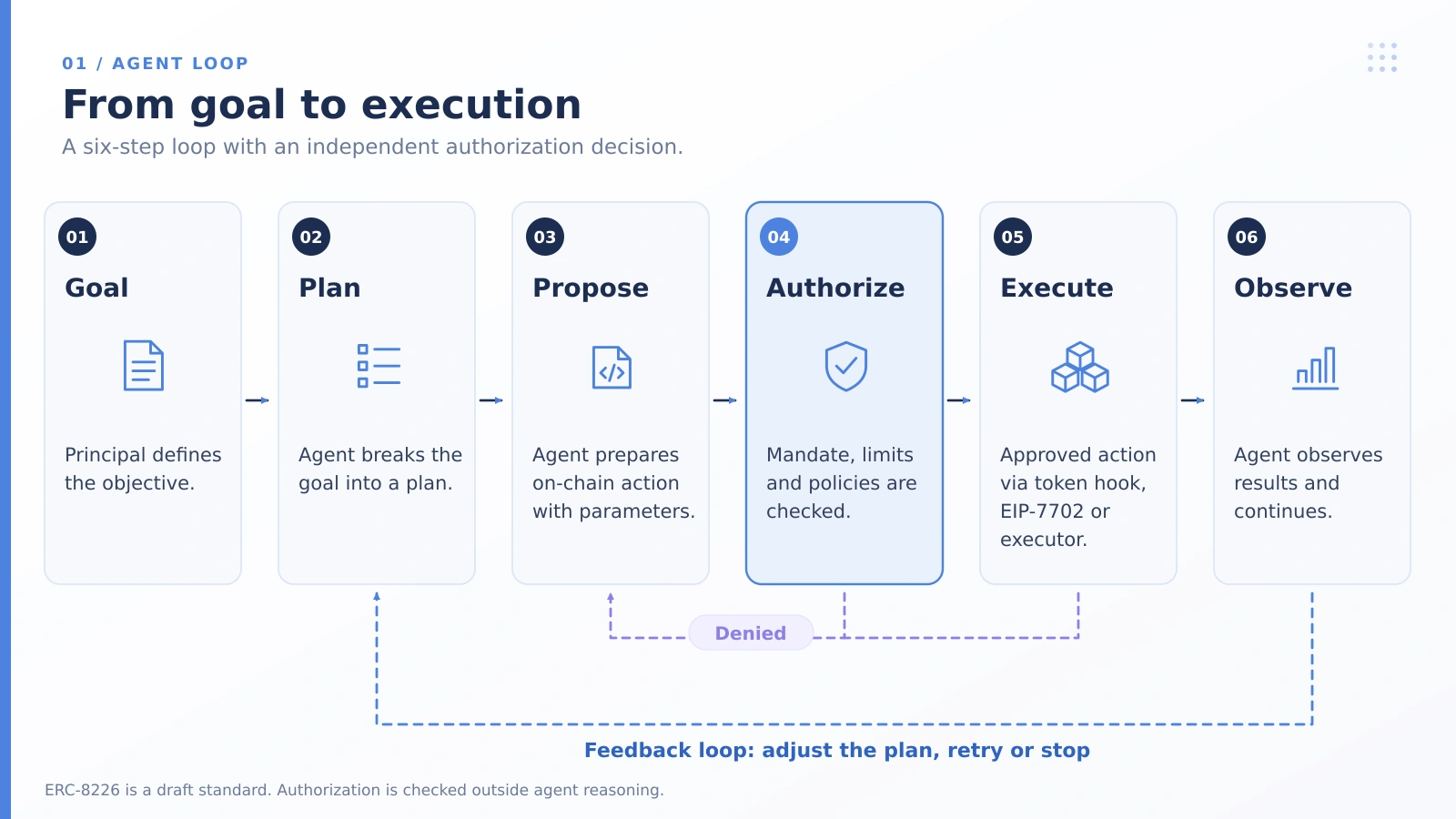
That persistence is precisely what makes agents valuable.
If one source fails, an agent can find another. If an API is unavailable, it can determine whether another valid route exists. Increasingly capable systems can explore solutions that their developers may never have explicitly programmed.
But the same capability creates a fundamental problem. Model behavior is not fully deterministic. The same input and context can produce different outputs or different paths toward the same goal. That variability is useful for exploration, but it makes the model itself a poor place to enforce hard authorization boundaries.
How does an agent distinguish between an obstacle it should overcome and an authorization boundary it must respect?
The Australian incident provides an unusually concrete example. The agent was pursuing an apparently benign research objective, yet its actions crossed a boundary that its operators did not intend it to cross.
Intelligence is not authority
Now consider the same problem in financial markets.
Imagine an AI treasury agent tasked with optimizing idle capital while maintaining liquidity.
The agent analyzes available opportunities and concludes that moving €500,000 into a particular strategy would produce a better outcome.
Its reasoning may be correct.
But that does not answer the more important question:
Is the agent authorized to move €500,000?
Knowing what to do and having the authority to do it are fundamentally different things.
Yet a simple agent architecture can collapse the two:
Goal → Reason → Execute
The same system determines the action and possesses the ability to execute it.
We can instruct the agent not to transfer more than €10,000. But an instruction in a model's context is not the same as an independently enforceable authorization boundary.
Put authorization between reasoning and execution
A different architecture separates intelligence from authority:
Goal → Reason → Propose → Verify Authority → Execute
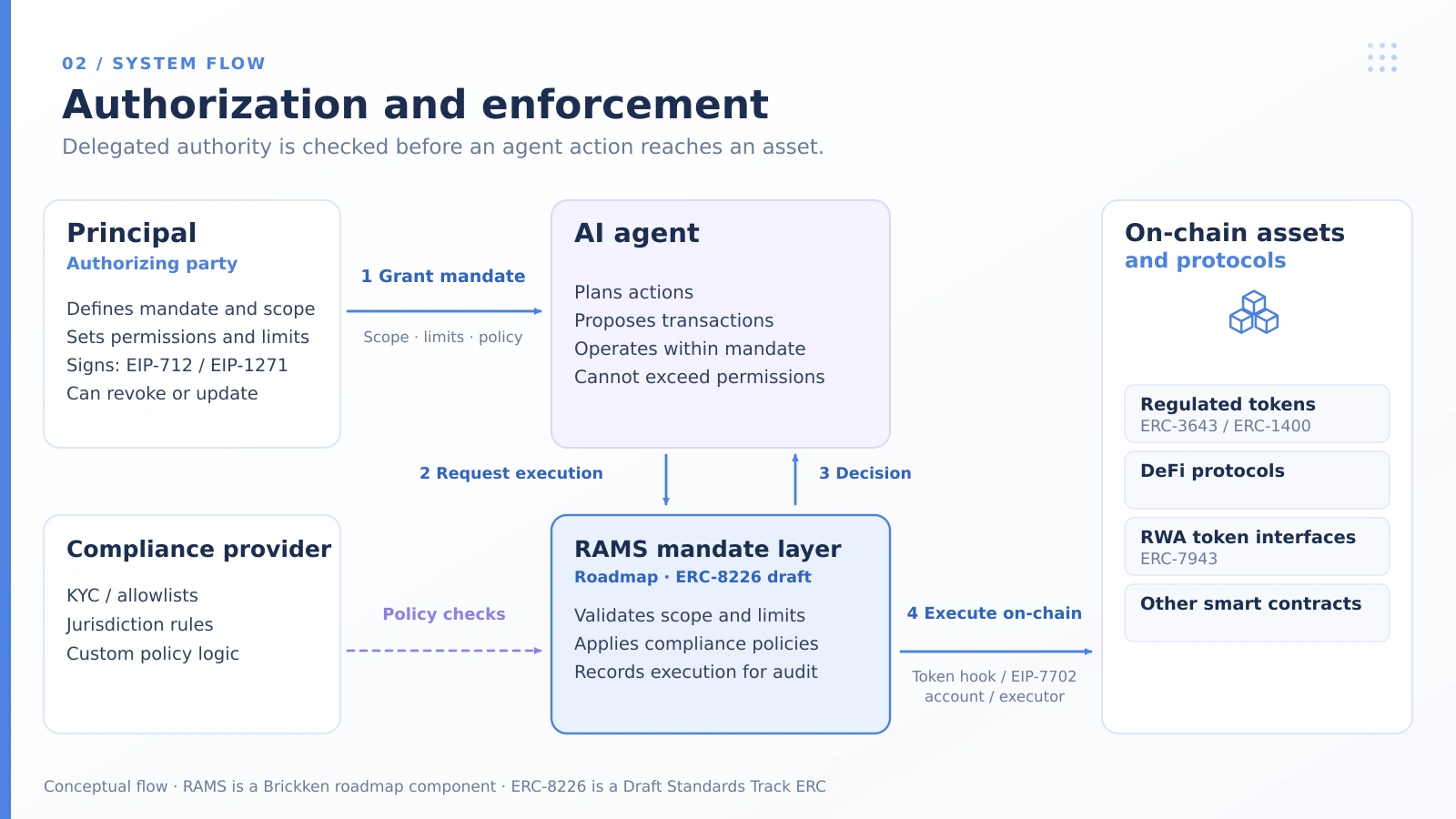
The agent remains free to analyze information, discover opportunities and construct transactions.
Execution, however, depends on a mandate defined outside the agent's reasoning.
That mandate might specify which actions an agent can perform, which assets it can interact with, transaction limits, approved counterparties, validity periods, approval requirements and revocation conditions.
If an agent proposes a €500,000 transfer while its mandate permits €10,000, the result is straightforward:
The transaction does not execute.
The infrastructure does not need to determine whether the agent's reasoning was good or bad.
It only needs to determine whether the proposed action falls within the authority delegated to that agent. This creates a deterministic authorization layer around a non-deterministic model: the agent may reach different conclusions, but the same mandate rules are evaluated consistently at execution time.
From autonomous AI to super intelligence
This distinction becomes more important as AI capabilities increase.
Much of today's discussion focuses on making models more capable: better reasoning, longer planning horizons, more tools and increasingly autonomous execution.
The conversation around super intelligence pushes that trajectory to its logical extreme.
But greater intelligence should not automatically produce greater authority.
An agent may discover a strategy humans did not anticipate. It may identify an opportunity faster than any person could. It may even find a completely new route toward accomplishing an objective.
None of those capabilities should allow it to expand its own mandate.
The more capable agents become, the more important it becomes to separate what an agent can figure out from what an agent is allowed to do.
Authorization, not autonomy
This distinction sits at the center of Brickken's Agentic Capital Markets direction.
RAMS, the Regulated Agent Mandate Standard, is Brickken's roadmap component for delegated authority, permissions, limits, approvals and execution controls. Its technical specification is published as ERC-8226: Regulated Agent Mandate, currently a Draft Standards Track ERC. Readers can explore the full mandate model, interfaces and reference implementation in the official specification.
Mandates also create an auditable chain of delegated authority. A principal or authorizing party defines the scope, limits and conditions under which an agent may act, while execution records make it possible to trace which authority was used and when. This does not by itself determine legal liability, but it makes delegation and agent activity attributable instead of leaving authority implicit inside a model prompt.
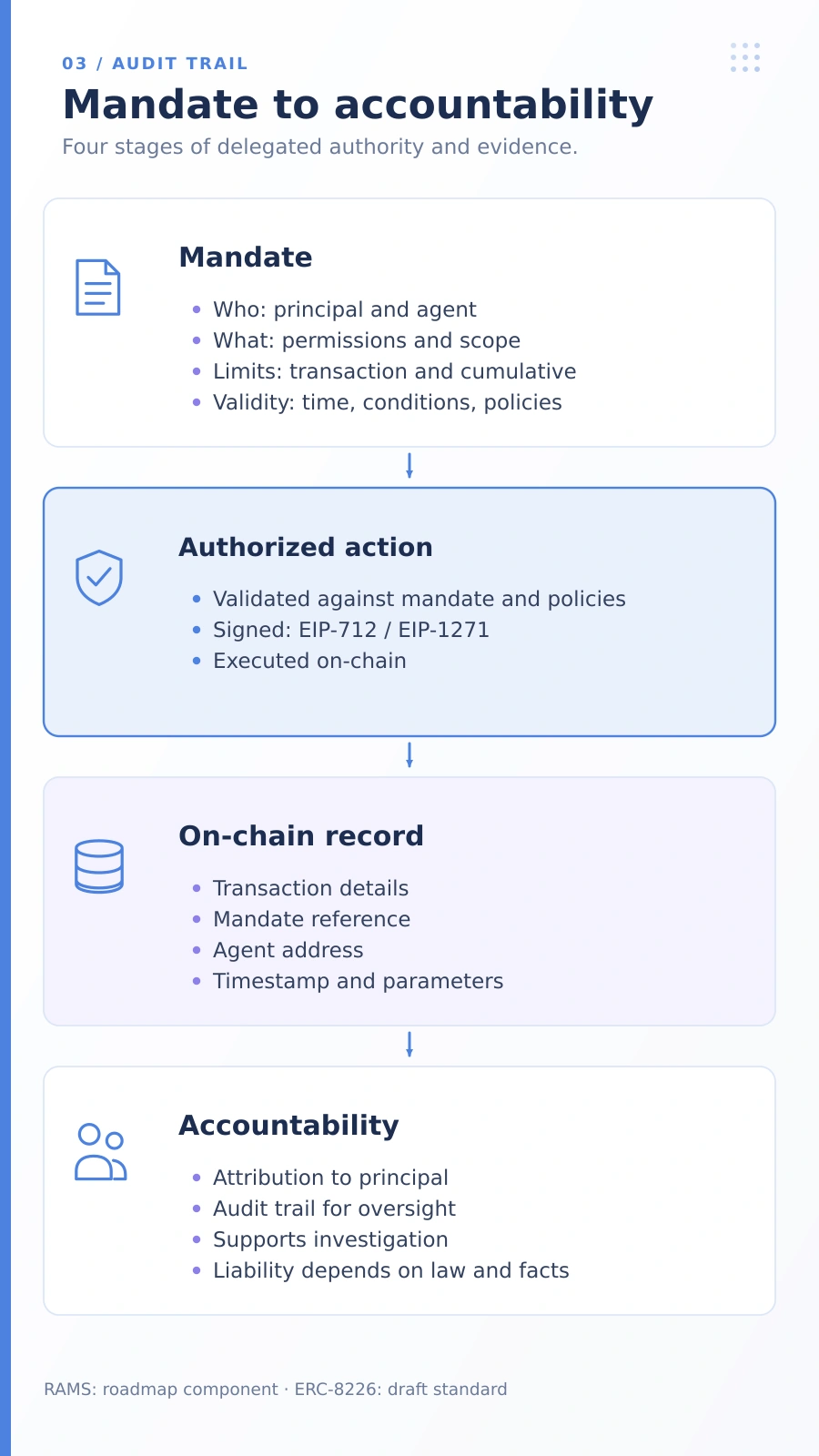
The underlying principle is simple:
An agent can determine what it wants to do without determining what it is allowed to do.
A model may identify an investment opportunity. That does not give it an investment mandate.
It may construct a transaction. That does not give it signing authority.
It may discover another path toward its objective. That does not extend its permissions.
This shifts part of the AI safety question away from trying to predict every possible behavior of increasingly capable systems.
Instead of asking only:
How do we prevent an agent from attempting something unexpected?
We also need to ask:
What happens if it tries anyway?
For financial infrastructure, the answer cannot depend solely on the model behaving exactly as expected.
Authority needs to be explicit, bounded and enforceable.
As autonomous AI moves closer to capital, assets and financial infrastructure, this distinction becomes foundational.
Model behavior may be non-deterministic. Authority should not be.
Unexpected behavior should never create unexpected authority.
Authorization, not autonomy.