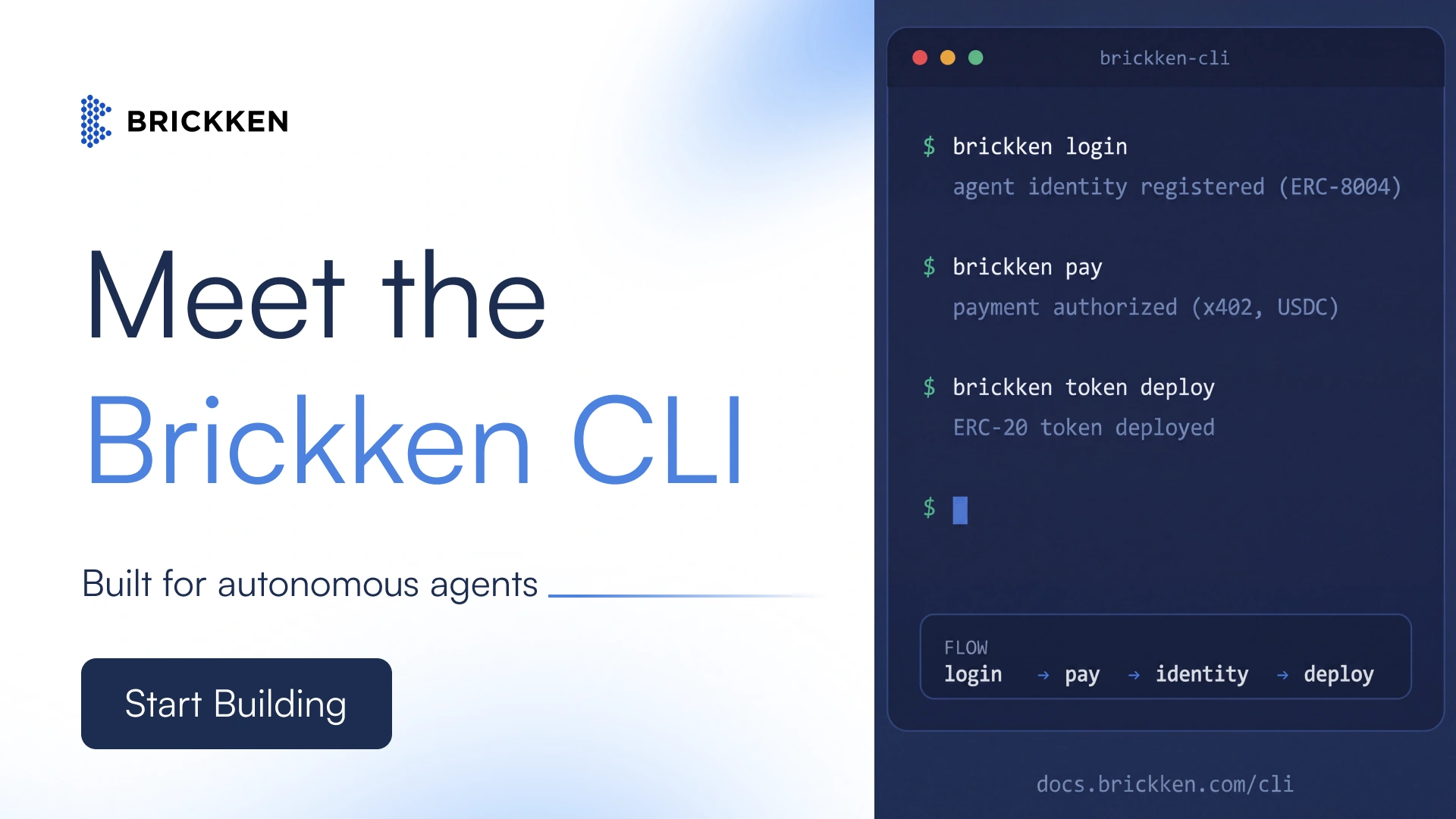
AI agents can now operate on-chain without browsers, API keys, or manual approval loops. The Brickken CLI combines x402 payments, ERC-8004 agent identity, and ERC-20 token deployment into a single terminal workflow, giving autonomous agents the infrastructure they need to pay, identify themselves, and execute blockchain transactions directly from the command line.
AI agents can already write code, execute tasks, and interact with software autonomously. What they haven't been able to do is participate directly in blockchain infrastructure without relying on human-operated interfaces.
They typically depend on browser sessions, API keys, manual approvals, or external orchestration before they can perform even simple on-chain operations.
That creates a gap between autonomous decision making and autonomous execution.
The launch of the Brickken CLI closes part of that gap.
The CLI allows an AI agent to register an on-chain identity, pay for API calls through x402, and deploy or manage an ERC-20 token directly from the terminal. No browser session. No API keys. No manual approval flow.
This is not simply another developer tool. It is infrastructure designed for agentic transaction workflows.
For an AI agent to operate independently, three capabilities need to exist simultaneously.
First, the agent needs a way to pay for services.
Traditional API authentication assumes a human developer manages billing, API keys, and accounts. Autonomous agents do not fit that model.
With x402, payment becomes part of the protocol itself. The agent pays for the API request as it executes it instead of relying on pre-issued credentials.
Second, the agent needs a persistent identity.
Without an on-chain identity, every interaction is effectively anonymous. There is no way to establish ownership, maintain reputation, or associate assets with a long-lived software agent.
The Brickken CLI integrates ERC-8004 identity registration, allowing agents to create and manage their own on-chain identity before interacting with other services.
Finally, the agent needs execution capabilities.
Once identity and payment exist, the remaining step is performing blockchain operations. Through the CLI, agents can deploy ERC-20 tokens and continue managing them without leaving the terminal.
Together, these three layers form a complete execution flow rather than isolated features.
The workflow is intentionally simple.
CLI
↓
x402 payment
↓
ERC-8004 identity registration
↓
ERC-20 deployment
A developer or the AI agent itself installs the CLI.
The agent authenticates using its wallet, pays for Brickken Agentic API requests through x402, registers its ERC-8004 identity, and executes token operations directly from the terminal.
Preparing transactions is free. Payment occurs only when the transaction is executed through x402, separating transaction construction from blockchain execution while keeping the workflow fully scriptable.
Because the CLI supports machine-readable JSON output, it also integrates naturally into automated pipelines and agent frameworks.
The CLI exposes the same operations available through Brickken's Agentic API.
Agents can:
The package also includes a bundled AI skill compatible with agent frameworks including Claude Code, OpenAI Codex, Gemini CLI, Cursor, and GitHub Copilot, allowing agents to understand when to use the CLI, the Agentic API, MCP, or other Brickken interfaces.
Instead of building custom integrations for every workflow, developers can automate the full lifecycle from inside their existing development environment.
The conversation around AI agents has largely focused on reasoning and planning.
The next challenge is operational.
An agent that cannot identify itself, pay for services, or execute transactions independently still depends on human infrastructure.
As autonomous software becomes more capable, the supporting infrastructure has to evolve alongside it.
Identity, payment, and execution are foundational building blocks for that evolution.
The Brickken CLI brings those components together into a single terminal workflow, allowing developers to move from agent setup to on-chain execution without switching environments.
For teams building autonomous applications, that reduces friction between decision making and execution and creates a practical path toward agent-native blockchain interactions.
The Brickken CLI is available today. Install it, register an on-chain agent identity, pay for API requests through x402, and deploy your first ERC-20 token all from the terminal.
Explore the documentation, follow the quickstart guide, and start building with the CLI:

