TL;DR
RWA vaults aggregate capital and allocate it across tokenized financial instruments under a defined mandate. They combine portfolio construction, eligibility controls, liquidity management, reporting and automated execution in one operating structure.
Their importance is not limited to yield. RWA vaults address the next constraint in tokenization: turning individually issued assets into products that institutions and professional allocators can assess, access and manage.
A credible RWA vault requires more than smart contracts. It depends on enforceable investor rights, reliable asset data, disciplined underwriting, machine-readable compliance, transparent valuation, defined redemption mechanics and clear responsibility across issuers, originators, curators, custodians and administrators.
A private-credit instrument can be issued on-chain and still attract no capital.
The legal structure can be complete. The investor register can be digital. Transfers can settle through a programmable ledger. None of this determines who will underwrite the exposure, how it will enter a portfolio, where liquidity will come from or what happens when an investor requests redemption before the underlying loan matures.
This is the gap RWA vaults address.
Tokenization established that financial instruments can be represented and administered on programmable infrastructure. The next stage concerns allocation and distribution: how tokenized assets become investable products, how capital moves between them and how compliance remains enforceable throughout the process.
The issue is no longer asset creation. It is capital coordination.
RWA vaults are moving from concept to product, and institutions now have to decide whether and how to use them. This article covers what a definition does not: why vaults are emerging now, who curates them, where the real risks sit (credit, duration and liquidity) and what to assess before allocating capital. For the definition and the step-by-step mechanics, read the RWA Vaults guide. To see how Brickken supports a deployment, see RWA Vaults.
Crypto markets have repeatedly demonstrated that high advertised yields do not necessarily represent productive economic returns.
Token emissions, liquidity incentives, recursive leverage and trading activity can generate returns while market participation is expanding. They become less reliable when incentives decline, collateral falls or liquidity contracts. The market stress of 2022 exposed how leverage, liquidity mismatches and interconnected protocol dependencies can amplify losses.
This has increased scrutiny of where yield originates, which assets support it and how the structure behaves under stress.
Tokenized Treasuries supplied one early answer. They connected on-chain capital to a familiar financial instrument with an identifiable issuer, established valuation practices and recognizable cash flows. Private credit, receivables and other financial assets expand the available sources of return, but they introduce more complex underwriting, servicing and liquidity requirements.
A standalone tokenized instrument does not resolve those requirements. An RWA vault packages them into a managed allocation structure.
The model is becoming more relevant because investors increasingly want managed exposure rather than the responsibility of selecting individual protocols, evaluating every originator and monitoring each collateral position themselves. Curated vaults combine strategy, asset selection, risk limits, liquidity terms and administration in a single product.
A tokenized private-credit note and an RWA vault perform different functions.
The note represents a specific financial claim. The vault determines whether that claim belongs in a broader portfolio, how much capital it should receive, how it interacts with other exposures and how investor liquidity will be managed.
This creates three distinct institutional layers.
The first layer supports issuance and administration. It covers the financial instrument, investor onboarding, compliance controls, subscriptions, records, transfers, distributions and reporting.
This is where tokenized assets are created and operated.
The vault sits above the individual instruments. It aggregates capital and allocates it according to a documented strategy.
Its role is to convert a fragmented set of opportunities into an investable product with defined risk, duration, diversification and liquidity parameters.
The third layer determines how capital is allocated within the mandate.
Today, these decisions are generally made by human investment committees, asset managers or specialist curators. Over time, approved software agents can assist with monitoring, rebalancing and execution. Institutional adoption depends on those agents operating under explicit mandates, financial limits and auditable controls.
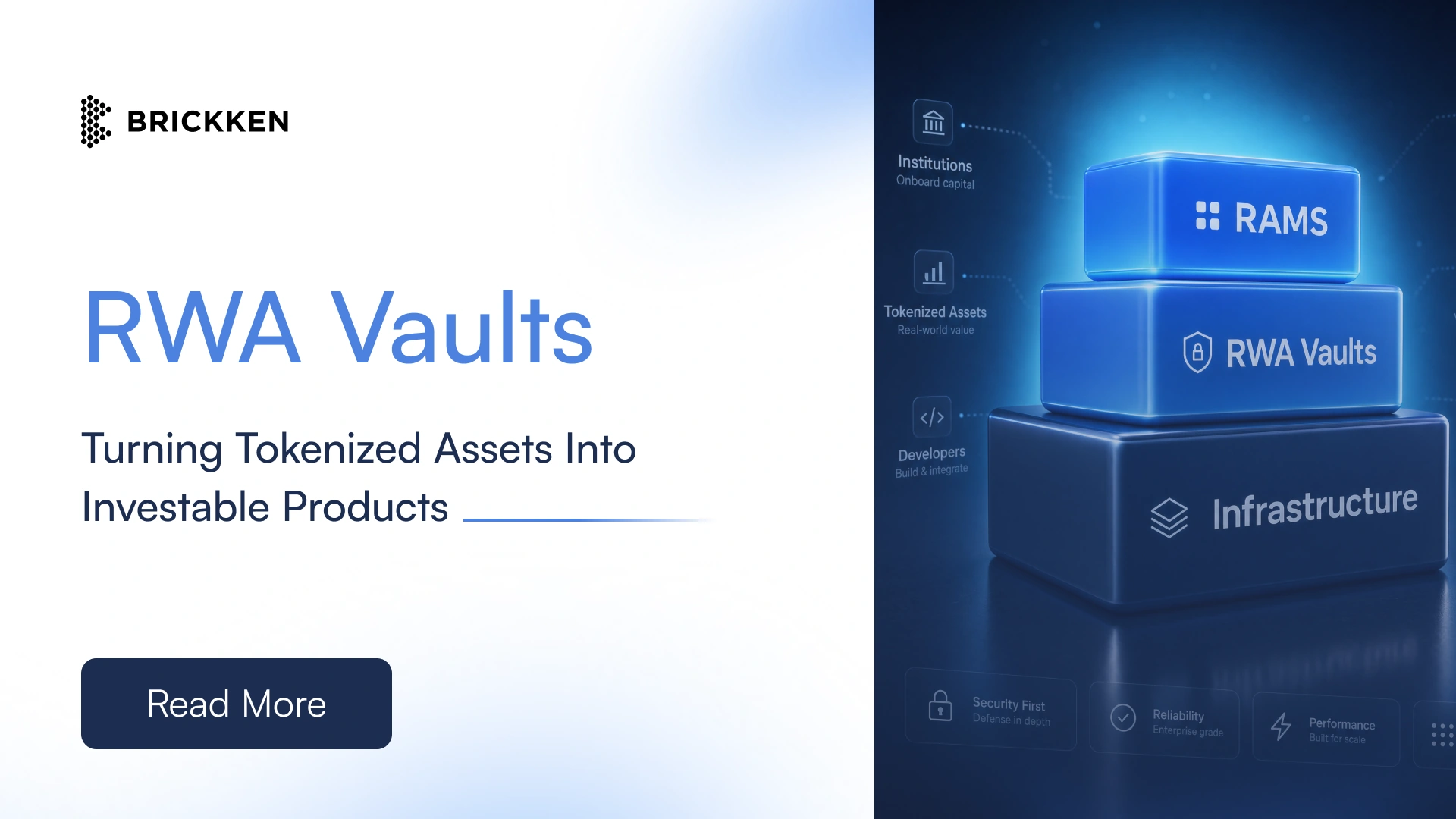
Brickken’s RWA vault strategy describes these as connected layers rather than separate products: tokenization infrastructure at the foundation, vaults as the financial-product and distribution mechanism, and regulated agent mandates as a capability governing automated allocation.
The curator performs a function comparable to portfolio management and risk oversight.
Depending on the structure, the curator can define:
The curator does not make the underlying risks disappear. It concentrates responsibility for evaluating and managing them.
This creates an important shift. Investors are no longer evaluating only a protocol or smart contract. They are evaluating the mandate, the quality of the curator’s decisions, the underwriting process and the operational controls surrounding the portfolio.
A vault with transparent code but weak asset selection remains a weak financial product.
The same applies to concentration. Where large volumes of capital follow a small number of curators using similar assumptions, vaults can transmit rather than reduce market stress. Liquidity terms, collateral quality and exit mechanics therefore matter as much as headline returns
The step-by-step workflow, from origination and underwriting through subscription, NAV and redemption, is covered in the RWA Vaults guide.
The credibility of an RWA vault rests on the quality of its underlying exposures.
For credit-oriented vaults, the central questions include:
Several structural protections can be used, depending on the instrument and jurisdiction.
An originator can retain a subordinated first-loss position, aligning its economics with portfolio performance. Collateral, insurance or contractual recourse can provide additional credit support. A portfolio reserve can absorb defined losses or liquidity requirements before senior investor distributions are affected. Investor cash flows can also rank ahead of sponsor performance economics.
These mechanisms reduce specific risks. They do not make the investment risk-free.
The underlying documentation, priority of claims and enforcement process remain decisive.
Liquidity is one of the most frequently misunderstood parts of RWA vault design.
Many real-world financial assets are not continuously liquid. A receivable can mature in 60 days. A private loan can run for several years. A fund can permit quarterly redemptions. Representing the instrument on-chain does not shorten its contractual duration.
A vault that offers faster investor redemption than the underlying portfolio can support creates a maturity mismatch.
That mismatch must be managed rather than hidden.
A robust liquidity framework can combine several sources:
A portfolio divided across short-, medium- and longer-duration assets can use natural maturities to fund a portion of redemptions. A liquidity sleeve can handle ordinary requests. Gates can protect remaining investors when requests exceed the capital available without forced selling.
An internal Brickken framework illustrates the underlying principle: shorter-duration assets provide liquidity, medium-duration assets form the core income engine and longer-duration positions supply additional yield. Capital is continuously recycled as assets mature.
Verification replaces assumption. Investors need to know not only that redemption is available, but exactly how it is funded.
Tokenized financial instruments can support approved wallet-to-wallet transfers. This can provide an additional exit route where both parties are eligible and the transfer complies with the instrument’s rules.
It does not guarantee a buyer.
Secondary liquidity still requires price discovery, eligible counterparties, custody access, settlement infrastructure and market demand. A transferable token with no active buyers remains illiquid.
For this reason, vault design should distinguish between:
Each mechanism has different legal, liquidity and risk consequences.
RWA vaults combine financial assets, investors and transactions across systems and, in some cases, jurisdictions. Compliance cannot sit outside the operating workflow.
The infrastructure must determine whether an investor or receiving wallet is eligible before a subscription, transfer or reallocation is completed.
Relevant controls include:
Machine-readable compliance translates these conditions into rules that institutional systems can evaluate during execution.
ERC-7943 is relevant to this architecture because it establishes common interfaces for regulated tokenized assets, including administrative and transfer-control functions. The objective is not to replace the legal rules governing the instrument. It is to make those rules operable across issuers, wallets, custodians and allocation systems. Brickken’s content strategy identifies this asset-level permissioning as one of the three foundations required for compliant programmable markets.
Portfolio automation already exists in conventional finance. The institutional question is how far it can extend when financial instruments and compliance controls are programmable.
Software agents can monitor exposure, compare eligible assets, prepare transactions and recommend rebalancing. An autonomous agent should not, however, receive unlimited authority over institutional capital.
It requires a mandate specifying:
RAMS, the Regulated Agent Mandate Standard described as ERC-8226 in Brickken’s strategy, is intended to formalize this delegation layer. It is designed to allow an agent to operate within defined and auditable boundaries rather than through a broad wallet permission.
This is the difference between automation and regulated agency.
The agent does not set its own authority. The institution defines it, the infrastructure enforces it and the activity remains reviewable.
Institutions should approach an RWA vault with the same discipline applied to a fund, credit strategy or structured product.
The assessment should cover four areas.
The institution should examine asset quality, borrower or issuer exposure, security interests, legal enforceability, payment priority, historical performance and servicing arrangements.
The institution should understand eligible assets, concentration limits, duration, use of leverage, liquidity reserves, rebalancing rules and the curator’s discretion.
The review should establish how subscriptions, custody, valuation, transfers, payments, reporting and compliance controls are administered—and which record is authoritative when on-chain and off-chain data differ.
Redemption windows, notice periods, gates, valuation methods, transfer restrictions and sources of liquidity should be explicit before capital enters the structure.
The advertised return is one data point. The institutional product is the full system of rights, controls and operational responsibilities behind it.
The importance of RWA vaults extends beyond portfolio automation.
Tokenized asset markets remain fragmented. Individual instruments can exist across different issuers, networks, jurisdictions and servicing systems. Most allocators do not want to integrate separately with every originator or administer a portfolio of isolated tokens.
Vaults create a common allocation and distribution layer.
They can give asset managers a structured channel through which tokenized instruments reach new pools of capital. They can give investors a managed entry point rather than requiring direct underwriting of each exposure. They can also direct liquidity toward originators and financial instruments that meet defined standards.
This changes where value accrues in tokenized markets.
Issuance remains necessary, but it is no longer sufficient. The scarce functions are underwriting, product construction, distribution, liquidity management and compliant allocation.
The market is moving from putting assets on-chain to making capital operate around them.
Brickken is tokenization infrastructure for financial institutions.
Brickken’s RWA Vaults product packages this layer for institutions.
Its role begins at the asset layer: issuer onboarding, financial-instrument creation, compliance execution, investor permissions, document workflows, lifecycle management and distribution infrastructure.
RWA vaults extend that infrastructure into product construction and capital allocation. They provide a mechanism through which tokenized financial instruments can be selected, combined and distributed under a defined mandate.
Brickken’s architecture connects three layers:
The vault is therefore a continuation of the infrastructure model, not a departure from it.
Tokenization answered how financial instruments can be represented and administered on programmable infrastructure.
RWA vaults address the harder question: how capital is allocated once those instruments exist.
A credible vault connects tokenized assets to disciplined underwriting, portfolio rules, investor eligibility, transparent valuation, liquidity management and enforceable redemption processes. It makes individual financial instruments usable as part of a managed product without obscuring their underlying risks.
The next stage of tokenization will not be measured by the number of assets issued. It will be measured by whether those assets can be distributed, financed, monitored and managed through infrastructure that institutions can trust.
The outcome is not a collection of tokens. It is a governed capital-allocation system connected to verifiable financial instruments.