Tokenization is no longer a side conversation in asset management.
It is increasingly becoming part of how major financial institutions think about fund infrastructure, investor access, operational efficiency, and long-term distribution.
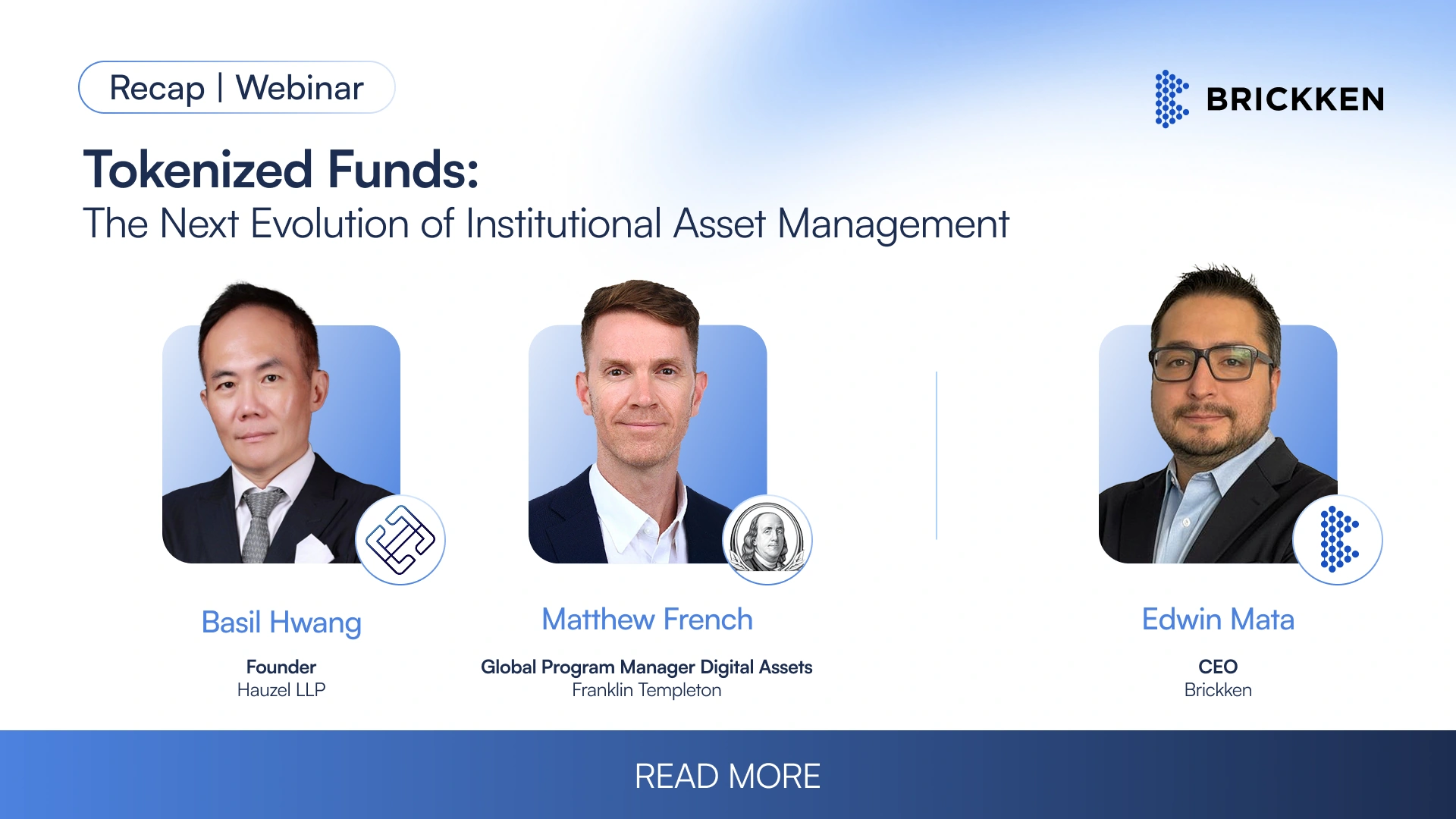
In our latest webinar, Tokenized Funds: The Next Evolution of Institutional Asset Management, Brickken CEO Edwin Mata spoke with Matthew French, Global Program Manager Digital Assets at Franklin Templeton, and Basil Hwang, Founder of Hauzen LLP, about what is actually changing in fund management as blockchain infrastructure matures.
The discussion covered adoption cycles, compliance realities, what “fully on-chain” really means, and why tokenized funds are not about reinventing finance, but upgrading its infrastructure.
Below are the main takeaways.
One of the clearest signals from the discussion was that tokenized fund infrastructure has already moved beyond proof of concept.
Matthew shared Franklin Templeton’s timeline in a way that makes the industry’s evolution very tangible:
That journey matters because it shows how institutional adoption actually happens: not overnight, but through gradual operational validation.
The important point is that tokenized funds are no longer hypothetical. They are already live, operating, and increasingly treated as part of normal product infrastructure.
A major theme in the webinar was that tokenization does not create a new legal universe for funds.
As Basil explained, the underlying legal and securities framework remains largely the same. If an instrument is a security, it is still treated as a security. The difference is not the legal nature of the fund. The difference is the technological layer through which ownership records, transfers, and operations are handled.
This is one of the most important concepts for institutions evaluating tokenization.
Tokenization does not require abandoning established legal structures. It means using blockchain as a more efficient infrastructure layer for:
This is also why institutional adoption is progressing. The move is not from legality to experimentation. It is from legacy infrastructure to modern infrastructure.
Another critical takeaway from the webinar was the role of compliance.
Both speakers made it clear that tokenized funds do not operate outside traditional controls. KYC, AML, investor verification, and regulatory obligations still apply. In many cases, scrutiny is even higher because of the historical association between blockchain and crypto markets.
Matthew noted that many of the off-chain compliance processes remain largely the same today. What changes is the delivery and ownership infrastructure, not the existence of controls.
Basil reinforced this by pointing out that regulators have become more comfortable with blockchain precisely because they have built clearer rules around what is allowed and what is not. For legal and compliance teams, that clarity is not a blocker. It is what enables adoption.
This matters because one of the biggest misconceptions in tokenization is that compliance becomes lighter. In reality, tokenized fund infrastructure succeeds only when compliance is embedded from the beginning.
One of the most practical parts of the discussion focused on what tokenization actually improves for fund managers and participants.
Matthew explained that blockchain infrastructure can dramatically reduce the operational cost of maintaining fund ownership records. That matters because it changes the economics of access.
In Franklin Templeton’s case, this allowed minimum participation sizes to move from the $5,000–$10,000 range down to around $20 for some tokenized money market fund access.
That is not a minor improvement. It fundamentally changes who can participate.
The implications are broader than just lower minimums. Tokenization can also improve:
This is one of the reasons tokenized funds are gaining momentum. They do not just digitize an existing product. They can make the product more accessible and operationally efficient.
The discussion also highlighted a more nuanced point: tokenization is not equally urgent for every fund structure.
Matthew made the distinction clearly. If a traditional fund is bought once and held for ten years, the benefits of tokenization may be incremental in the near term. But where tokenization becomes especially compelling is in assets or products where:
This is why tokenized money market funds and collateral use cases are attracting so much attention. The value is not just in putting the asset on-chain. It is in what that enables operationally.
One of the strongest moments in the webinar came when the conversation moved from tokenized funds themselves to the broader market infrastructure around them.
The panel made a crucial point: tokenized funds do not operate in isolation.
For the full benefits of tokenization to materialize, the surrounding ecosystem also needs to move on-chain, including:
This is especially relevant for fund settlement. Even if the asset can move instantly on-chain, cash settlement and valuation processes may still be constrained by traditional infrastructure.
As Matthew put it, the industry is still only scratching the surface. The fund layer is evolving, but the broader financial stack still has to catch up.
Another useful insight from the discussion was why asset managers are paying attention now.
Matthew pointed to a very practical business reality: in asset management, costs continue to rise while fees continue to compress. That creates pressure to improve efficiency and rethink infrastructure.
In that context, blockchain is not interesting because it is new. It is interesting because it has the potential to reduce operational costs, improve client experience, and open new distribution channels.
That is a very important framing.
Institutional adoption is not being driven by hype. It is being driven by the search for more efficient operating models.
The panel also touched on one of the most strategic long-term implications of tokenized funds: distribution.
Matthew noted that a new generation of participants is already familiar with wallets, digital assets, and on-chain financial products. As wealth moves from one generation to the next, tokenized fund access through wallet-native infrastructure could become a major shift in how asset managers distribute products.
This opens up a broader possibility:
funds may eventually sit alongside other digital assets in a single wallet environment, creating new expectations around ownership, access, and product design.
That does not mean traditional channels disappear. It means distribution could expand far beyond them.
Throughout the webinar, both speakers returned to a common point: tokenization is not a radical break from financial markets.
It is an infrastructure upgrade.
Basil compared the shift to the historical move from paper share certificates to electronic records. The legal right did not change. The infrastructure did.
That is the right lens for tokenized funds as well.
The market is not replacing asset management. It is modernizing how asset management operates.
The key message from the webinar was clear:
tokenized funds are becoming a practical infrastructure layer for institutional asset management.
The drivers are not speculation or novelty. They are:
The next phase of asset management will not be defined only by what assets are offered. It will also be defined by how those assets are issued, recorded, distributed, and operated.
And increasingly, that infrastructure is moving on-chain.
Watch the full webinar here: https://landing.brickken.com/tokenized-funds-ondemand

