Consensus Miami confirmed what is already visible across private markets: tokenization is no longer being discussed as a future market structure. It is being evaluated, implemented, and integrated into institutional workflows.
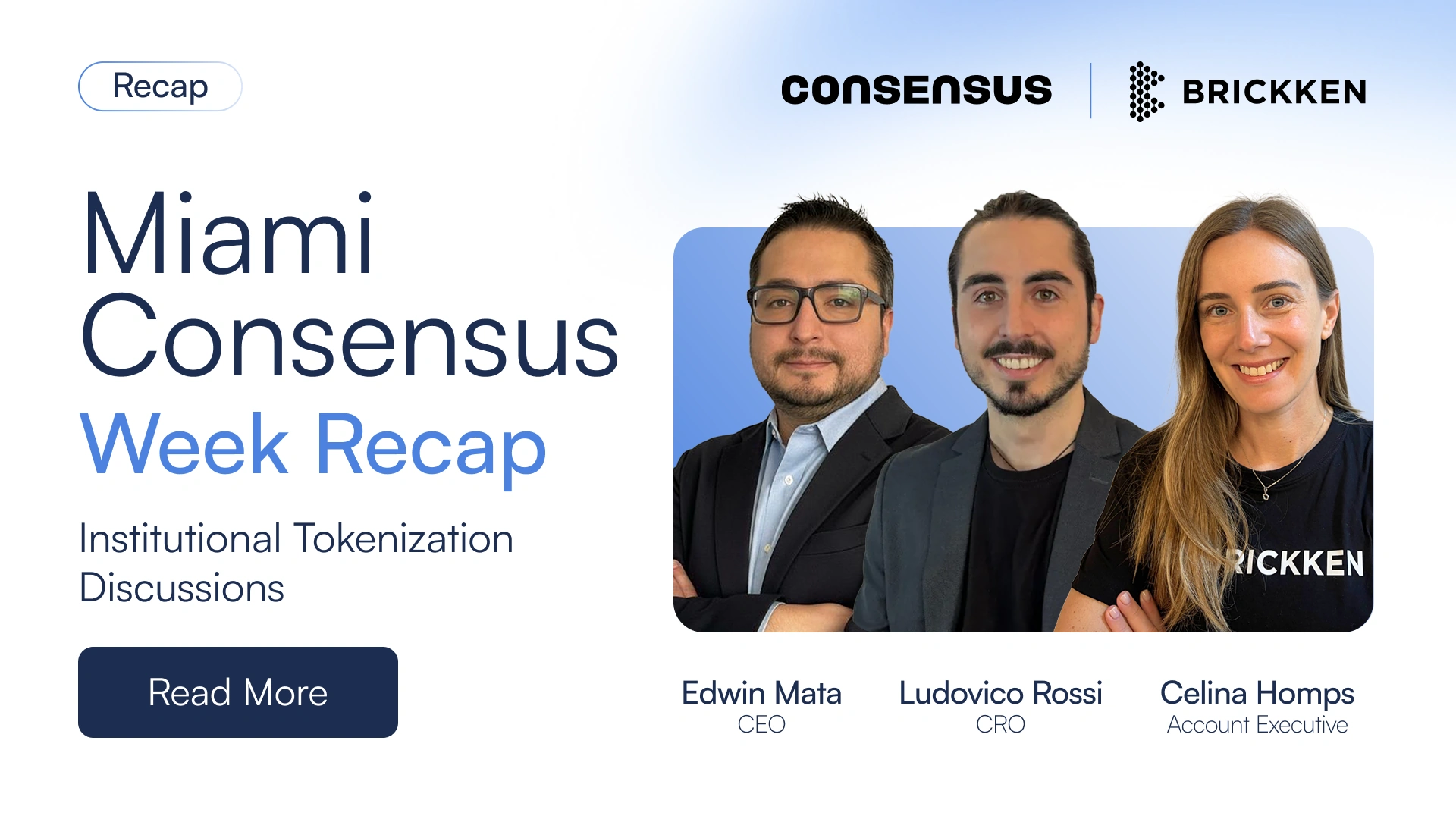
Our team was on-site throughout the week, with CEO Edwin Mata, CRO Ludovico Rossi, and Account Executive Celina Homps; meeting with enterprises, asset managers, ecosystem partners, and financial institutions working on tokenized financial instruments.
Across the week, Brickken held more than 40 strategic meetings. The signal was consistent: institutional demand is no longer centered on whether real-world assets will scale on-chain. The market is now asking who can provide the compliance, issuance, distribution, and lifecycle infrastructure required to support them.
The conversations in Miami were not about whether real-world assets belong on-chain. That question has largely been settled. The relevant question is now operational: how financial assets are structured, issued, managed, distributed, and serviced within existing regulatory and institutional frameworks.
That is where we operate.
Miami has become a financial gateway for the Americas, connecting US institutional capital, LATAM financial markets, digital asset infrastructure, and global private market activity.
Consensus Miami also represented an important milestone in Brickken’s US expansion strategy. The event enabled direct engagement with North American institutions, capital allocators, and strategic partners as we continue strengthening our presence in the region.
During Consensus week, the focus was clear. Institutions are moving beyond exploratory discussions and into implementation planning. The strongest conversations centered on corporate debt, private equity, real estate-backed structures, tokenized funds, and compliant issuance frameworks.
Compared with previous market cycles, the tone was significantly more execution-oriented. Conversations focused on real deployments, regulatory readiness, secondary transfer models, institutional onboarding, and operational infrastructure rather than theoretical adoption.
Institutions are not looking for speculative asset exposure. They are looking for infrastructure that allows them to issue and manage financial instruments with clear ownership records, investor onboarding, compliance controls, reporting workflows, and lifecycle management.
Tokenization is becoming an operating layer for private markets.
We were selected as a CoinDesk PitchFest semi-finalist at Consensus 2026, placing our infrastructure for tokenized private markets in front of active capital deployers, institutional leaders, and digital asset decision-makers.
Our CEO Edwin Mata presented our infrastructure for issuing and managing real-world assets, with a focus on the operational requirements behind institutional tokenization:
During PitchFest, Brickken also unveiled its upcoming RWA Vault infrastructure, designed to support programmable, yield-generating real-world asset products with integrated compliance, servicing, and investor management capabilities.
The interest around RWA Vault reflected one of the clearest signals from Consensus Miami: institutions are moving from simple issuance platforms toward infrastructure that can support active capital deployment, lifecycle management, and controlled participation in tokenized financial products.
CRO Ludovico Rossi later took the main stage for the PitchFest final, presenting the operational reality of tokenization: legacy financial systems are not being replaced by speculation, but upgraded through infrastructure capable of issuing, distributing, and managing capital globally.
The message was direct. The market narrative has shifted toward real-world assets, but real adoption depends on the infrastructure behind them.
“The next phase of tokenization will not be won by who tokenizes first, but by who builds the infrastructure capable of supporting institutional capital at scale.” Edwin Mata, CEO and Co-Founder of Brickken
Before Consensus officially began, Edwin Mata joined the Digital Asset Yield Summit for a panel on tokenization, RWA use cases, and real yield.
The discussion reflected the same market direction seen across the week. Institutional tokenization is now focused on compliant issuance, lifecycle management, and infrastructure that can support real financial instruments at scale.
One of the strongest market signals from Consensus was the growing institutional focus on income-generating tokenized structures and programmable financial products. This aligns directly with the next phase of Brickken’s infrastructure roadmap and the introduction of RWA Vault.The institutional opportunity is not limited to asset representation. It lies in the operating model: how assets are onboarded, verified, issued, distributed, monitored, and serviced after issuance.
At Consensus Miami, the discussion around tokenization was more precise than in previous cycles.
The market is moving away from broad claims about “putting assets on-chain” and toward the specific systems required to make tokenized assets work in regulated environments. This includes compliance execution, investor verification, transfer controls, asset servicing, reporting, custody coordination, settlement workflows, and liquidity pathways.
In a CCN interview during Consensus week, Edwin Mata discussed why the digital asset market is returning to blockchain’s core utility: efficient, compliant financial infrastructure.
Several themes defined the conversation:
Stablecoins as a catalyst
Stablecoins continue to function as one of the main bridges between traditional finance and digital asset markets. Their adoption is shaping how institutions think about settlement, liquidity, and the movement of value across jurisdictions.
Regulation as a commercial edge
Compliance is not a secondary layer in institutional tokenization. It is a core requirement. Institutions need infrastructure that embeds KYC, AML, investor qualification, jurisdictional restrictions, and transfer controls into the operating model.
Open standards and interoperability
Institutional adoption requires infrastructure that can operate across ecosystems. Brickken’s work on open standards, including ERC-7943, reflects the importance of multi-chain compatibility, standardized asset logic, and infrastructure that avoids isolated deployments.
Expansion of the institutional stack
Tokenization infrastructure increasingly needs to connect issuance, custody, brokerage, liquidity, and settlement. The market is moving toward end-to-end execution, where tokenized financial instruments are not only created, but actively managed throughout their lifecycle.
One of the clearest trends in Miami was the shift from simple issuance platforms toward full lifecycle infrastructure.
Institutions are increasingly evaluating tokenization providers based on operational scalability, compliance automation, interoperability, liquidity enablement, and post-issuance management capabilities.
This is the difference between creating a token and operating a financial instrument.
A tokenized asset does not become institutional because it exists on-chain. It becomes institutional when the full operating model is in place: onboarding, compliance, documentation, issuance, ownership tracking, reporting, distributions, transfer controls, asset servicing, and investor lifecycle management.
That is the infrastructure layer now being assessed by financial institutions and capital allocators.
The strongest signal from Miami was not attendance, market visibility, or stage presence. It was the quality of institutional demand.
Enterprises, asset managers, family offices, and financial institutions are no longer asking basic questions about tokenization. They are asking how to deploy it inside existing business models.
The operational questions are more advanced:
These are infrastructure questions. They are also the questions that determine whether tokenization remains a digital wrapper or becomes a functional capital markets layer.
Consensus Miami reinforced the direction of the market.
The next stage will be defined by the institutions that can operate tokenized financial instruments with compliance, precision, and scale.
Consensus Miami was one step in a broader institutional expansion.
Our next industry engagements include:
PropTech Miami | May 12 - 13
Focused on the intersection of real estate, financial infrastructure, and tokenized asset models.
WebX Tokyo | July 13–14
A key institutional and digital asset event in Asia, where Brickken will continue conversations around tokenized financial instruments, infrastructure deployment, and private market digitization.
The market is moving from isolated tokenization projects to integrated infrastructure. Brickken is building for that phase.
Explore how tokenization infrastructure is evolving in practice.
Book a demo with our tokenization experts.

