Real estate is the world’s largest asset class and one of the hardest to modernize. With an estimated $300T in global value, it sits at the center of the next phase of on-chain finance. But the industry is past the “what if” stage. The question now is: what does real-world deployment require to scale?
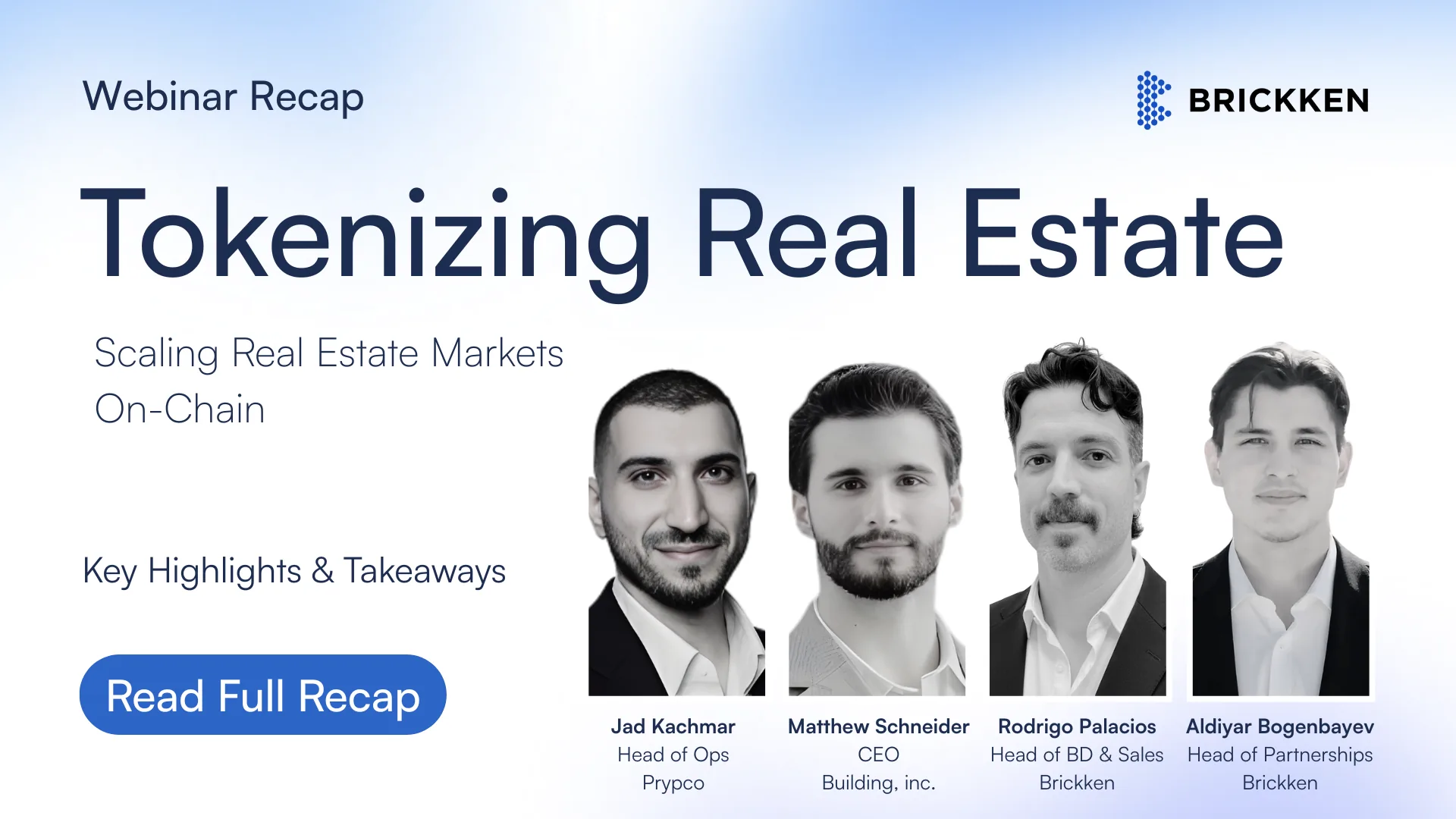
In our recent webinar, Real Estate on the Ledger, we brought together operators working at the edge of execution:
Below are the most important segments, capturing where the market is headed, what’s blocking scale, and what “tokenization-ready” actually means in practice.
Matthew opened with a framing many teams quietly share but rarely articulate clearly: tokenized real estate is finally approaching an inflection point, but only because the foundations are catching up.
“We’re at the right inflection points of regulatory clarity, technology and infrastructure development.”
The key change is that the conversation has moved away from high-level storytelling and toward the hard mechanics of market formation.
“The gravity of the conversation has shifted from high-level theory to grounded… regulatory requirements that enable actual trading.”
This is the signal for 2026: real estate tokenization is becoming a market design problem, not a branding problem.
One of the strongest moments of the webinar was the shared pushback against a common misconception: tokenization is not a silver bullet for liquidity.
Matthew made it explicit:
“If we are talking about immediate liquidity, that tells me we’re having a conversation that is still a few years behind.”
Instead, serious issuers focus on operational quality: auditability, traceability, data standards, and repeatable workflows.
“If we’re talking about auditability, traceability, standardizing their real estate data… then I know we’re in the right place.”
Jad reinforced the same principle from an operator’s lens:
“If innovation is not here to solve a problem, it’s going to most likely create one.”
Tokenization-ready isn’t a label, it’s a capability. It’s a combination of:
Real estate is not like treasuries. It has many moving parts, tenants, maintenance cycles, insurance, utilities, valuation assumptions, and local jurisdictional nuance.
Matthew’s perspective was clear: data is the weakest link in scaling tokenized real estate.
“Tokenization is the last step in a very long equation.”
And “tokenization-ready” will remain subjective until markets converge on standards:
“There’s going to be a spectrum of tokenization readiness… It’s quite a matrix to describe what tokenization-ready means.”
This matters because functional capital markets require fresh, credible information, not once at issuance, but continuously through the asset lifecycle.
“A year goes by… someone is looking to sell. The question is: has any of that information been updated?”
This is where many pilots fail: the asset is tokenized, but the information infrastructure behind it is not.
The discussion turned practical when the hosts asked about compliance and legal structuring.
From the U.S. viewpoint, Matthew summarized the baseline reality:
“Tokenized real estate… are securities. They are going to follow securities laws.”
And he noted that beyond securities laws, there are layered requirements, real estate compliance, tax, reporting, investor protection, and the rules for what happens when something goes wrong.
On the UAE side, Jad laid out a progression model that’s useful for any jurisdiction:
“The most important model… is direct ownership tokenization. You’re tokenizing the title deed directly rather than tokenizing an SPV.”
This is a key market signal: jurisdictions that can tokenize at the title level are pushing closer to true institutional-grade rails.
A major question for direct-title models is governance: if thousands of people own fractions, who makes decisions?
Jad addressed this with real operational examples, from legally binding ownership documentation to voting mechanics.
“The token ownership certificate… is a legally binding document… issued by government.”
And governance isn’t theoretical, Prypco has mechanisms for investor voting tied to performance triggers:
“If the property appreciates… we engage the investors in a voting process… If we achieve majority, we go ahead and sell.”
This is a key point for the broader market: tokenization requires governance design, not just smart contracts.
One of the most valuable segments was the closing discussion on liquidity. Jad was direct:
“Tokenization on its own does not solve for liquidity.”
Liquidity comes from a combination of:
Jad outlined multiple paths Prypco is exploring:
“What if I can just send my token to a lender in exchange for a stablecoin… that increases utility… and liquidity.”
And he connected liquidity to settlement rails:
“Stablecoins… help achieve atomic settlement… instant delivery versus payment.”
The takeaway is clear: liquidity is not a feature, it’s an ecosystem outcome.
In the final question, Aldiyar asked what would take tokenized real estate from early adoption to mainstream.
Matthew’s answer: it’s a system-wide equilibrium of regulation, technology, and information infrastructure.
“The answer has to be all of the above… when we find equilibrium, that’s when the market will take off.”
He also offered a sober reminder: we are attempting to financialize an asset class that still struggles with coordination and transparency.
“We might be getting ahead of ourselves.”
Jad added the institutional catalyst:
“When institutions come into the mix and start investing in tokenized RWAs… that’s where we’re going to see massive shifts.”
This aligns with where the industry is heading: tokenized real estate scales fastest when it becomes institutional market infrastructure, not a retail novelty.
Across both perspectives, data infrastructure and operational execution, one message stood out:
Real estate tokenization is moving into production only where markets can support:
This is the shift from pilots to platforms, and it’s the environment Brickken is built to serve.
Missed the Webinar?
You can watch the full session here: https://www.youtube.com/live/IYQ4cDJj9YM?si=EaDYB0zNDB-4Stwx