By Yassir Haouati, COO & Co-Founder @ Brickken
TL;DR:
Financial institutions are increasingly adopting AI agents, creating opportunities to improve how financial workflows are coordinated and executed. Realizing these benefits requires an operating architecture that connects authoritative financial information, institutional responsibilities, delegated permissions, and verifiable execution.
This article proposes a practical framework for organizing humans, AI agents, and financial systems around accountable operations. Using a hypothetical tokenized bond coupon distribution, it examines how institutions can engineer workflows, manage exceptions, preserve financial controls, and measure operational value. It also explores how programmable asset infrastructure can support the transition toward AI-native financial institutions.
Imagine a financial institution preparing a scheduled coupon distribution for a tokenized corporate bond.
The servicing team needs to retrieve the contractual terms, determine eligible holders, calculate payment entitlements, verify available funds, authorize distribution instructions, and reconcile the resulting transactions. Each activity involves financial information, specialized systems, operational responsibilities, and approval requirements.
Now consider introducing an AI agent capable of coordinating parts of this workflow.
The agent could collect relevant information, prepare an entitlement report, investigate discrepancies, assemble payment documentation, and monitor processing status. Authorized personnel and financial systems would remain responsible for the decisions and transactions assigned to them.
The institution would need to establish which activities the agent can perform, which information it may access, how its actions are authorized, and how completed work is verified.
This scenario illustrates an increasingly relevant question for financial institutions:
How can intelligent software become part of daily financial operations while preserving institutional accountability and control?
The transition is already underway.
The Bank of England and Financial Conduct Authority's October 2026 AI survey received responses from 196 financial firms, with 105 completing its detailed questionnaire. Among respondents to the relevant agent questions, 80% reported having deployed AI agents, while only 2% reported agents operating with broad autonomy. The survey's autonomy categories overlap, and its findings describe participating firms rather than the entire UK financial sector.
This difference illustrates the current state of institutional adoption. AI agents are entering financial organizations, while consequential operational authority remains tightly controlled.
The engineering challenge now extends beyond deploying intelligent systems. Institutions need operating models that allow those systems to participate reliably in financial processes.
Financial institutions have used automation for decades. Core banking systems process transactions, trading infrastructure executes orders, control applications monitor activities, and enterprise software coordinates internal workflows.
These systems typically operate through predefined rules, structured inputs, and established business processes.
AI agents introduce the ability to interpret context, investigate unfamiliar situations, coordinate activities across applications, and propose actions based on changing information. Their potential becomes particularly interesting when integrated into recurring financial operations.
Consider a conventional servicing workflow involving several departments. An upcoming payment event may require operations staff to collect documents, request updated records, verify calculations, coordinate with treasury, obtain approvals, and follow up with external service providers.
An AI-native approach could allow software agents to coordinate selected activities across these systems, prepare information for the responsible professionals, and monitor progress against defined requirements.
I would describe an AI-native financial institution through 4 connected capabilities:
Together, these capabilities allow AI to become part of the institution's operating infrastructure.
The organizational implications are equally important. AI-supported processes affect responsibility allocation, internal controls, information governance, technology integration, staff capabilities, and operational performance management.
In October 2026, the Financial Stability Board published 12 sound practices for responsible AI adoption. Its recommendations emphasize organization-wide governance, management accountability, data quality, appropriate oversight, performance evaluation, and third-party risk management.
These considerations become increasingly relevant as AI systems receive access to operational workflows and financial infrastructure.
Financial activities rely on information that carries legal, economic, and operational significance.
An agent assisting with financial servicing may need to understand contractual rights, relevant counterparties, payment conditions, account information, authorization requirements, and transaction status.
These records often originate from different systems and organizations.
A bond's contractual documentation may define its payment obligations. A registrar or another designated recordkeeping system may establish entitlement information. A servicing application may maintain the operational schedule, while a payment provider holds information about completed transfers.
The agent needs a reliable way to retrieve and interpret the relevant information while preserving the authority of each source.
This requires several infrastructure capabilities:
Financial records need clearly identified sources, consistent definitions, and appropriate access controls.
For an AI-assisted workflow, the institution should establish which system governs each material fact and how conflicting information will be resolved.
This becomes especially important when financial data moves between applications or when documents are updated during an active process.
Tokenization creates opportunities to represent financial instruments and their associated information through programmable digital infrastructure.
The International Capital Market Association's guidance on DLT bonds distinguishes between bonds issued natively on distributed ledgers and traditional bonds represented through tokens.
The legal significance of the token, the authoritative ownership record, and the responsibilities of participating institutions depend on the instrument's structure and applicable jurisdiction.
For AI-assisted operations, machine-readable asset interfaces can make relevant information about instruments, restrictions, balances, and lifecycle events easier for authorized software to access.
Financial institutions also need mechanisms that connect an agent's identity with the activities it is permitted to perform.
A mandate can define the agent's scope, financial limits, approved counterparties, permitted actions, approval requirements, and validity period.
Execution systems can then evaluate proposed actions against the relevant institutional policies.
The final infrastructure requirement concerns the systems responsible for actual financial operations.
These may include transaction preparation services, approved signing mechanisms, payment providers, custody infrastructure, ledgers, and reconciliation applications.
The institution needs to connect AI-assisted preparation with the controls governing these systems and the records that establish the resulting transaction status.
At Brickken, these infrastructure questions are central to our work on programmable financial markets.
Our Agentic Capital Markets Guide examines the technical foundations through a 7-layer institutional control architecture, covering machine-readable assets, agent identity, delegated authority, execution, settlement, and governance.
The guide provides a deeper technical reference for understanding how AI agents could interact with tokenized financial infrastructure under institutional control.
From an operating perspective, the next challenge is determining how these capabilities fit into an institution's daily processes.
One of the most important questions in AI-native financial operations concerns the allocation of responsibilities.
A financial workflow can involve an institutional principal, operations personnel, risk and control functions, technology teams, external service providers, and execution systems.
Introducing AI agents adds another participant to this environment.
For the operating model to function reliably, the institution needs to determine how these participants interact and which responsibilities remain assigned to each one.
I propose organizing the architecture around 3 operational participants, supported by institutional governance.
People remain responsible for the institution's objectives, applicable policies, risk appetite, and material business decisions.
An operations owner defines the purpose of a workflow and its expected results. Risk and control professionals establish relevant controls and escalation requirements. Treasury and servicing personnel exercise the financial responsibilities assigned to them.
These responsibilities may involve several organizations, depending on the financial instrument and servicing arrangements.
AI agents can support the operational work required to move a process forward.
They can retrieve information from approved sources, examine records, identify inconsistencies, prepare documentation, coordinate activities, and report execution status.
Their operating scope should be established through explicit permissions and supported by controlled interfaces.
For example, an agent authorized to prepare a payment instruction may retrieve supporting information and generate the proposed transaction package. The ability to submit or authorize that transaction would depend on its separately defined permissions and the institution's approval requirements.
Financial applications perform the functions that require deterministic rules, authoritative records, or specific transaction mechanisms.
These include entitlement calculations, payment validation, transaction signing, balance updates, and reconciliation.
Separating these functions allows institutions to use AI for context-dependent coordination while maintaining the established controls governing financial transactions.
The IMF's April 2026 analysis of agentic payments provides a useful perspective through its distinction between intent, authorization, and settlement.
That separation is particularly relevant when an AI agent interprets an objective and prepares actions that affect financial systems.
The proposed operating model can be summarized through the following responsibility structure:
| Participant | Primary responsibility |
|---|---|
| Institutional operations owner | Defines workflow objectives, accountable parties, and expected outcomes |
| Risk, control, and technology functions | Establish policies, access controls, monitoring, and escalation requirements |
| AI agents | Investigate, prepare, coordinate, monitor, and report within delegated scope |
| Authorized financial personnel | Exercise assigned approval and financial decision responsibilities |
| Financial execution systems and service providers | Validate, execute, record, and reconcile authorized financial activities |
The final allocation of responsibilities depends on the institution's legal structure, service-provider arrangements, regulatory obligations, and internal governance.
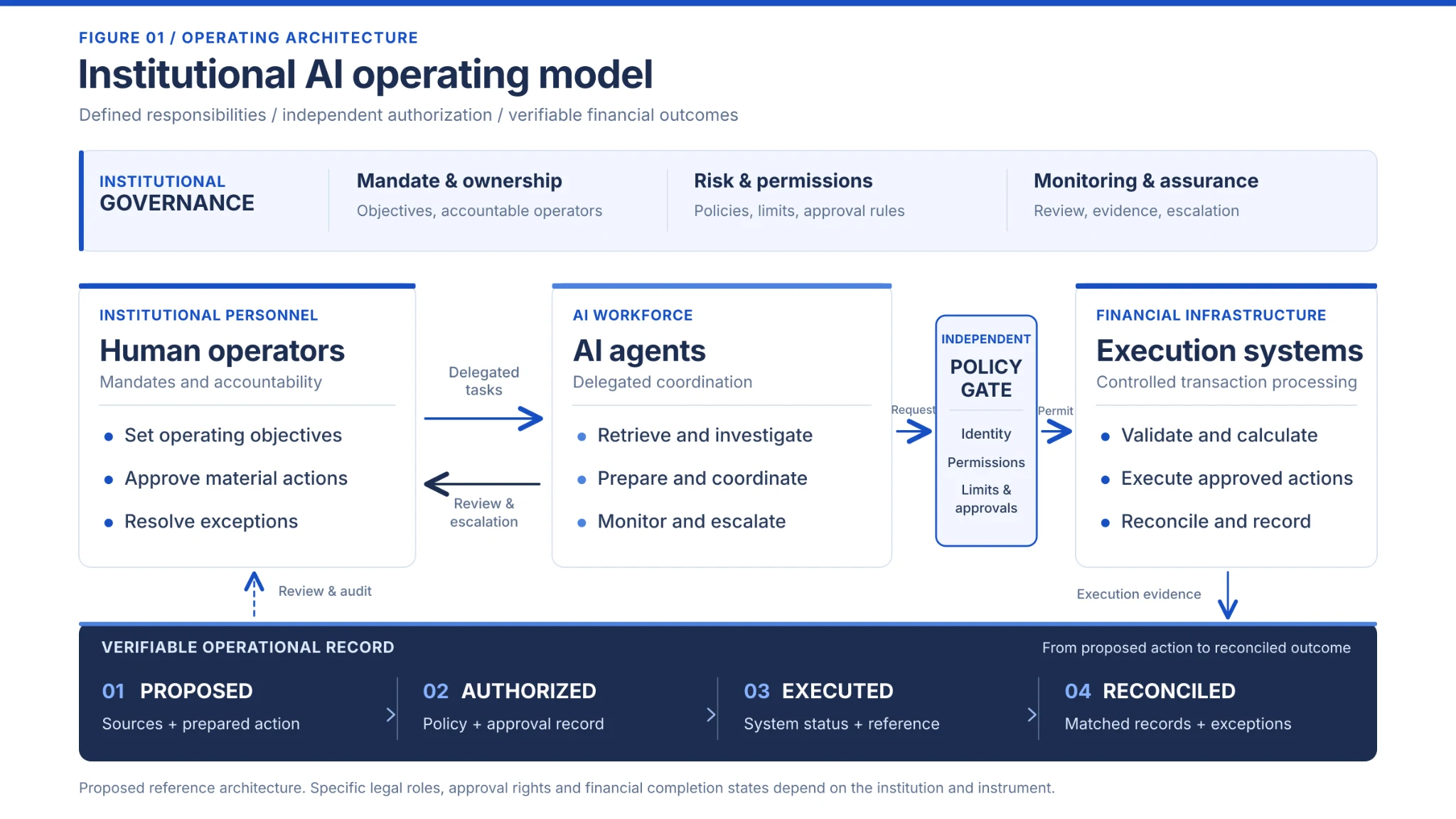
In this model, the agent participates in a workflow whose authority and accountability are established independently of the agent's reasoning.
The institution can therefore evaluate the agent's performance alongside the effectiveness of its operating controls.
The proposed operating model becomes easier to evaluate through a specific financial activity.
Consider a hypothetical institution responsible for coordinating the coupon distribution of a tokenized corporate bond.
The issuer has an outstanding debt instrument with defined payment terms. Depending on the instrument's structure, the servicing process may involve a registrar, custodian, paying agent, treasury team, and external payment or settlement infrastructure.
The institution wants to introduce an AI agent to assist with the operational preparation and coordination of the coupon event.
The workflow could be organized as follows:
The process begins when a scheduled coupon date approaches.
The agent retrieves the approved payment schedule and relevant instrument documentation through authorized systems.
It creates or updates an operational servicing case, identifies the relevant tasks, and establishes the expected processing milestones.
The operations owner remains responsible for the servicing process and its required completion conditions.
The agent retrieves the information needed to determine the relevant payment obligations.
This may include contractual interest terms, the applicable record date, legally authoritative holder or entitlement records, and relevant servicing instructions.
Where the instrument uses a distributed ledger, the agent may also retrieve token balances and transfer information.
The financial structure determines how these records establish legal entitlements. Token balances and registered ownership information must be interpreted according to the instrument's governing documentation.
The agent can assist by comparing sources, identifying missing information, and reporting discrepancies.
Once the required records are established, the servicing system calculates the coupon entitlements.
The calculation follows the instrument's contractual methodology, including the applicable principal, interest rate, accrual convention, and relevant payment conditions.
A deterministic calculation engine performs the computation.
The AI agent can prepare the supporting analysis, organize the calculation results, and identify records requiring further examination.
The responsible personnel or approved validation controls then evaluate the results according to the institution's procedures.
With the entitlement information validated, the agent assembles the proposed distribution package.
This could contain the relevant beneficiary information, calculated amounts, payment references, supporting documentation, and required approvals.
The agent also verifies whether the package meets the workflow's completeness requirements.
Treasury personnel and other designated parties review funding availability and any applicable payment conditions.
The proposed instructions proceed through the institution's established authorization process.
Relevant permissions, transaction limits, approval requirements, and signing controls are evaluated before execution.
The appropriate paying agent, payment provider, or financial execution system processes the approved instructions.
The agent may monitor status through permitted interfaces and report progress to the responsible operations team.
An instruction accepted by a system represents a particular stage of processing. The institution must also establish the subsequent payment or settlement outcome through the appropriate authoritative records.
Following execution, the servicing process compares expected entitlements with actual payment confirmations and relevant financial records.
The agent can assist by collecting transaction references, organizing reconciliation evidence, identifying unmatched items, and preparing exception reports.
The authoritative reconciliation process determines whether the financial event has been completed according to the institution's requirements.
The final servicing record should preserve the relevant approvals, execution references, reconciliation results, and unresolved exceptions.
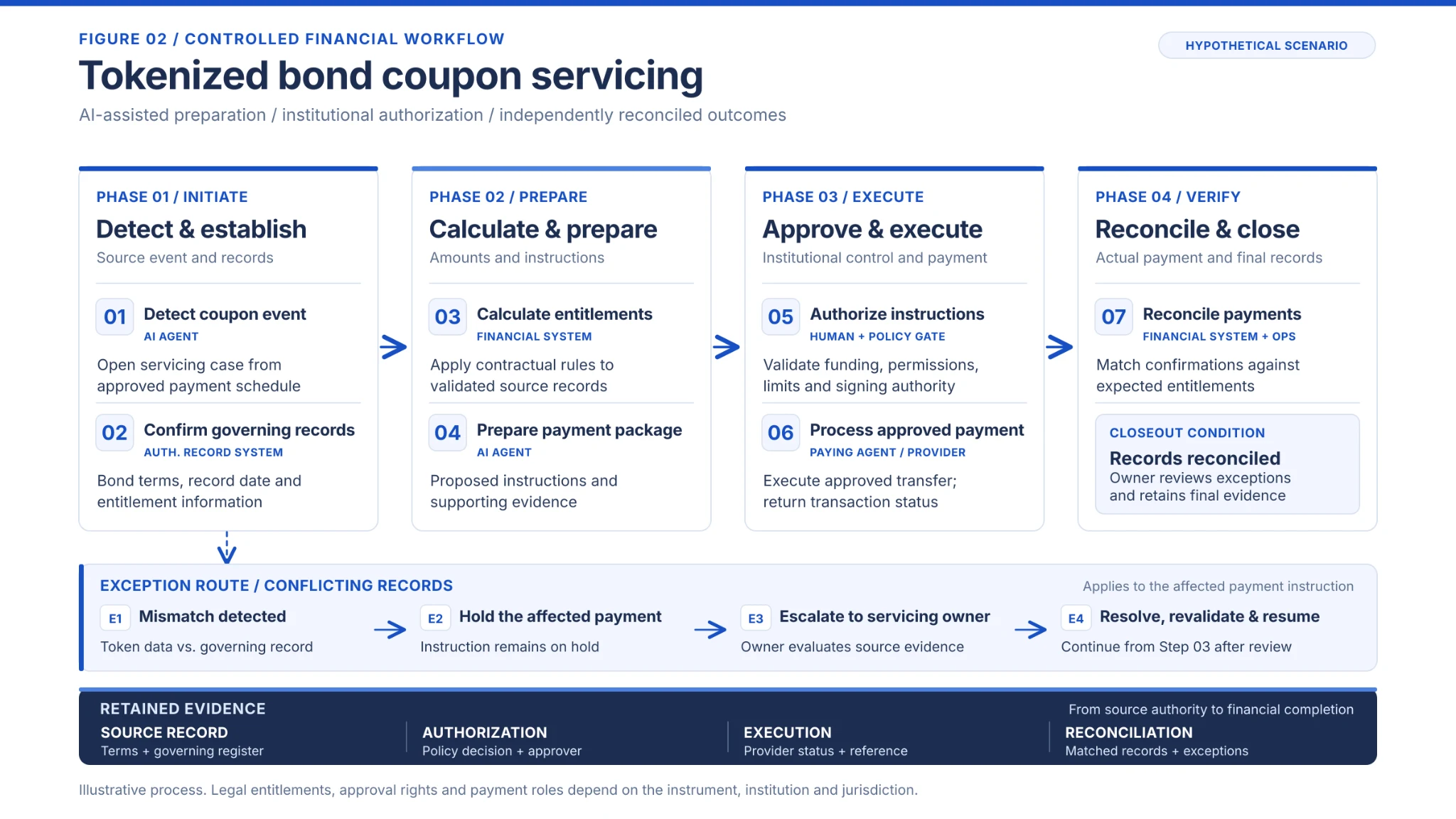
This example illustrates how intelligent coordination can be introduced into a financial workflow while retaining the specialized systems and accountable participants required to complete it.
Actual implementation would depend on the governing law, instrument documentation, authoritative register, service-provider responsibilities, payment arrangements, and supported system interfaces.
The reliability of a financial operating model becomes particularly important when a workflow encounters unexpected conditions.
Return to the hypothetical coupon distribution.
Suppose the agent identifies a discrepancy between the token-holder information and the legally authoritative entitlement records for one investor.
The records indicate different holdings at the applicable record date.
The agent can retrieve the relevant evidence, identify the inconsistency, and prepare an exception report.
The institution's servicing policy determines how the discrepancy is investigated, which personnel are responsible for resolving it, and whether the affected payment instructions can proceed.
The agent's contribution lies in accelerating the investigation and organizing the information required for a decision.
This scenario illustrates several broader engineering requirements.
Financial workflows need mechanisms for validating source data and identifying outdated, incomplete, or conflicting records.
For AI agents, provenance becomes especially important because retrieved information can influence subsequent actions.
These controls may include restricted credentials, transaction limits, approved resources, authorization periods, and human approvals for designated activities.
The NIST guidance on agent identity and authorization emphasizes unique agent identities, scoped credentials, and established access-management practices.
Financial workflows must account for technical failures, timeouts, duplicate instructions, uncertain transaction status, and unavailable external systems.
Transaction identifiers, idempotency controls, status verification, and reconciliation procedures help institutions manage these conditions.
The institution also needs to monitor agent behavior, evaluate performance, investigate incidents, and maintain a process for suspending or modifying permissions.
Oversight should reflect the materiality and risk of each activity.
In the Bank of England and FCA's 2026 survey, pre-deployment data risk controls were reported more widely than several ongoing monitoring and review practices. That difference highlights the operational work involved in supervising AI systems after deployment.
The FSB's October 2026 sound practices similarly emphasize lifecycle risk management, effective oversight, cybersecurity, and third-party dependencies.
For financial institutions, resilience requires that these controls remain effective throughout the workflow, including when AI systems or connected services behave unexpectedly.
From an operating perspective, the introduction of AI should ultimately improve the performance of a financial process.
That improvement needs to be measurable.
A servicing workflow may become faster because an agent retrieves documents, prepares information, and coordinates follow-ups more efficiently.
The institution may also benefit from improved consistency, earlier exception detection, and greater visibility into operational status.
These benefits should be evaluated alongside the costs of deploying and maintaining the system.
AI-assisted workflows introduce expenses associated with model usage, infrastructure, integration, monitoring, maintenance, and human supervision.
The institution may also need to invest in better data quality, access controls, operational procedures, and staff training.
For a recurring financial process, I would evaluate performance across 5 dimensions:
| Dimension | Measurement |
|---|---|
| Operational efficiency | Processing time per event, human review effort, processing capacity |
| Financial accuracy | Calculation discrepancies, payment errors, reconciliation results |
| Control effectiveness | Authorization failures, unresolved exceptions, control incidents |
| Reliability | Successful workflow completion, recovery time, system availability |
| Economic performance | Total operating cost per fully reconciled event |
One useful measure for a coupon-servicing workflow is the total attributable cost per successfully reconciled event.
Cost per reconciled event = Total attributable workflow cost / Successfully reconciled events
Total attributable cost should include appropriate allocations for implementation, infrastructure, model execution, supervision, maintenance, and exception handling.
The comparison should use the institution's existing process as its baseline.
For example, an institution could measure whether AI-assisted preparation reduces manual processing time while preserving the required levels of financial accuracy and control.
It could also evaluate whether operational staff can manage a larger number of servicing events with the same resources.
These outcomes require testing under representative operating conditions.
The financial assessment becomes particularly useful when the institution understands how costs and performance change as transaction volume increases.
An effective operating model should provide visibility into the relationship between AI consumption, operational capacity, control requirements, and completed financial work.
The transition toward AI-native operations can begin with a defined financial workflow.
Institutions can progressively introduce intelligent coordination while retaining their established systems, financial responsibilities, and governance arrangements.
I would approach implementation through 5 stages:
Identify a recurring workflow with a clear institutional owner, documented procedures, and measurable outcomes.
Suitable starting points may include financial reporting preparation, servicing-event coordination, document verification, or operational exception management.
The institution should establish the existing processing cost, level of manual effort, operational risks, and expected improvement.
Document the authoritative information sources, participating teams, external service providers, approval requirements, and financial execution mechanisms.
This exercise identifies where an agent could contribute and which dependencies need to be addressed before deployment.
Define the agent's responsibilities, approved information sources, permitted activities, financial limits, authorization requirements, and escalation procedures.
Technology and security teams should implement the corresponding identity and access controls.
Evaluate the agent using historical or simulated cases with known outcomes.
The institution can begin with information retrieval, analysis, and preparation activities before introducing authorized execution within appropriately defined limits.
Testing should include exceptions, unavailable systems, invalid data, and attempted actions outside the approved mandate.
Once the workflow demonstrates acceptable performance, the institution can evaluate opportunities to extend its scope.
Expansion decisions should reflect reliability, operational costs, control effectiveness, processing capacity, and the risks associated with additional activities.
Financial institutions also need infrastructure capable of supporting the relevant asset and transaction workflows.
Brickken provides tokenization infrastructure through 3 commercial deployment models:
These offerings provide infrastructure foundations upon which institutions can develop more connected operating processes.
Brickken's broader Agentic Capital Markets architecture explores how standardized asset interfaces, verifiable claims, machine-readable capital mandates, market intelligence, and delegated agent authority could support increasingly sophisticated coordination across capital markets.
Its strategic components include:
These components form part of Brickken's broader product and standards roadmap, with deployment availability and implementation scope determined by the relevant product documentation and agreements.
For institutions evaluating AI-native financial operations, the practical starting point is to connect a defined business process with the financial infrastructure, information, and controls required to operate it reliably.
Financial infrastructure is becoming increasingly programmable, creating opportunities to connect financial instruments, operational records, and institutional processes through more interoperable systems.
AI agents introduce another capability into this environment: the ability to interpret information, coordinate work, and assist with activities that previously required substantial manual preparation.
For financial institutions, the next stage of adoption will depend on how these capabilities are integrated into existing responsibilities and financial controls.
An effective AI-native operating model needs authoritative information, clear delegation, reliable execution systems, accountable oversight, and verifiable outcomes.
These foundations can support an evolution in how institutions administer assets, coordinate financial activities, manage operational complexity, and allocate resources.
Is your institution exploring tokenized assets, more connected financial operations, or the infrastructure required to support AI-driven workflows?
Speak with Brickken's specialists to discuss your institutional use case, explore our tokenization infrastructure, and identify practical next steps for implementation.
During a discovery call, our team can help you assess the available solutions and how they align with your organization's objectives.